

Eastern Wolf: Profile, Facts and Algonquin Range Guide
6 min read
The eastern wolf (Canis lycaon), also called the Algonquin wolf or eastern timber wolf, is a medium-sized wolf of the Great Lakes region of southeastern Canada and the adjacent northern United States. Its taxonomy has been argued about for a century: distinct species, gray wolf subspecies, or an ancient hybrid lineage, depending on whose genome paper you read. In the field it is a slim tawny-brown animal of roughly 25 to 35 kg, sitting between a coyote and a gray wolf in size. To test what you know, try our 12-question eastern wolf quiz.
Key facts at a glance
| Common name | Eastern wolf, also Algonquin wolf, eastern timber wolf |
| Scientific name | Canis lycaon (contested; sometimes Canis lupus lycaon) |
| Family | Canidae |
| Shoulder height | 60 to 75 cm |
| Body length | 1.1 to 1.4 m |
| Weight | 23 to 36 kg |
| Diet | White-tailed deer, beaver, moose calves, snowshoe hare |
| Habitat | Mixed boreal and temperate forest, lake country |
| Pack size | 3 to 6 |
| Lifespan | 5 to 6 years in the wild |
| Status | Threatened under Canada’s Species at Risk Act since June 2024 (COSEWIC, 2015); Threatened in Ontario as the Algonquin wolf since June 2016 |
| Population | Likely fewer than 1,000 mature individuals, minimum 236 (COSEWIC) |
Identification: the wolf between coyote and gray
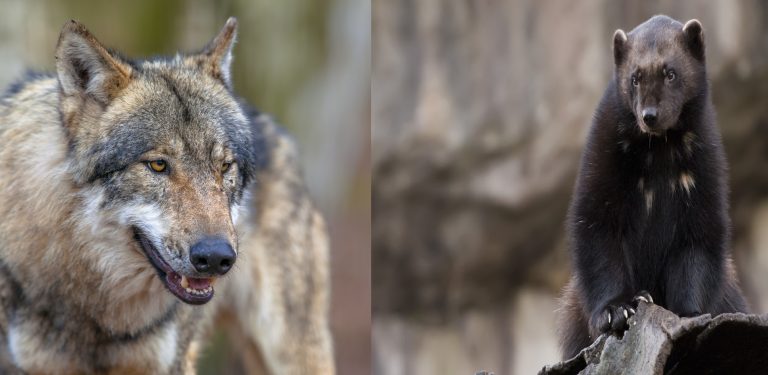
Adults weigh 23 to 36 kg, males slightly larger. The coat is tawny brown with cinnamon and grey overtones, paler than a gray wolf and warmer than a coyote. The muzzle is long and narrow, the ears upright and in proportion, the legs long. Summer coat is shorter and noticeably redder; winter coat thickens and lightens.
Telling one from an eastern coyote in the field is hard and often impossible. The eastern coyote tops out around 20 kg and has a narrower head and longer ears for its body size. The wolf carries its tail straight or slightly raised where the coyote holds it low. Across much of the range the two interbreed and DNA is the only reliable separation.
Range and habitat
The core range is Algonquin Provincial Park in eastern Ontario and the adjoining provincial parks, with animals also in parts of Quebec. Outside that protected core the population thins fast and hybridisation with eastern coyote becomes the norm. Historically the species reached south to the Adirondacks, west to Wisconsin, and possibly as far as the Carolina piedmont before persecution and land clearance pushed it back onto the Canadian shield.
Preferred habitat is mixed boreal and temperate forest with high beaver and white-tailed deer density. The lake country of the shield, where regenerating cuts and old-growth mosaics meet hundreds of lakes, holds the highest densities. COSEWIC puts the population at likely fewer than 1,000 mature individuals, with a minimum of 236, most of them in and around the Algonquin core.
The taxonomy argument
The 2016 whole-genome study by vonHoldt and colleagues concluded that eastern wolves are an admixture of gray wolf and coyote, with roughly 60 percent wolf to 40 percent coyote ancestry, and put red wolves in the same category. A 2017 response led by Hohenlohe challenged the generation-time assumptions and the choice of reference specimens, arguing the same data are consistent with an ancient hybridisation or a genuinely distinct origin, and that the genetic distinctness on show is high.
The argument is not settled and may not be settleable with current methods. It has not stopped the animal being protected. COSEWIC assessed the eastern wolf as Threatened in 2015, and Ontario listed it provincially as the Algonquin wolf, also Threatened, on 15 June 2016. The federal government followed on 17 June 2024, listing the Eastern Wolf (Canis sp. cf. lycaon) as Threatened under the Species at Risk Act.
The official names differ by body. In 2015 COSEWIC, Canada’s national assessment committee, assessed it as Canis sp. cf. lycaon, a canid believed to be lycaon with the question left open. Ontario went further in 2016 and listed the Algonquin wolf as Canis sp. The Mammal Diversity Database of the American Society of Mammalogists lists the eastern wolf as a full species, Canis lycaon.
Federal law caught up in June 2024, when an order under Canada’s Species at Risk Act (SOR/2024-135) moved the eastern wolf from Special Concern to Threatened on Schedule 1. A Threatened listing brings legal protection and a recovery strategy, which is why the naming question carries so much weight.
Diet, pack life, hunting
White-tailed deer is the main winter prey across most of the range. Beaver are taken in summer when they come out of the water to cut trees, moose calves in spring, snowshoe hare all year. Compared with gray wolves, eastern wolves lean far more heavily on beaver, which underwrite both summer and winter diets in Algonquin.
Packs are smaller than gray wolf packs, typically three to six adults plus that year’s pups, working territories on the order of 150 square kilometres.
Reproduction and lifespan
The breeding pair mate in February and produce four to six pups in mid-May. Dens go under rock outcrops or into sandy banks. Pups leave the den at six to eight weeks and are travelling short distances with the pack by late summer. Dispersal usually happens at one to two years old.
Average life expectancy in the wild is five to six years. Most recorded deaths are human-caused: hunting, trapping and vehicle strikes. Mortality inside the park boundary runs considerably lower than outside it, which is the entire argument for the buffer protection.
Algonquin and the buffer ban
Algonquin Provincial Park, established in 1893, is the only place the eastern wolf has held a continuous protected population. Wolves were still heavily hunted immediately outside the park boundary until December 2001, when Ontario banned hunting and trapping of wolves and coyotes in the surrounding townships.
That buffer ban is the single most effective measure taken for this animal. Ontario’s own assessment is that mortality from hunting and trapping fell significantly afterwards, and the protection has since been extended to other core occurrence areas in the province.
Where to hear one
Seeing an eastern wolf is unlikely: the territories are large and the forest is thick. From 1963 until Ontario Parks ended the programme in August 2022, Algonquin Park’s Public Wolf Howls gave visitors a chance to hear one: they drove out in convoy to a roadside point at dusk, a staff member howled, and sometimes the pack answered.
For a guaranteed sighting rather than a chance one, the Haliburton Forest Wolf Centre in central Ontario keeps a captive pack visible year round.
Threats and outlook
Hybridisation with eastern coyote is the main ongoing threat. Outside the protected buffer the two interbreed freely and the offspring trend coyote-dominant over generations. Inside it, pack stability and the availability of same-species mates keep hybridisation low. Vehicle strikes on Highway 60 through the park are the next mortality source, and shifting deer and beaver distributions are the emerging long-term worry.
Related reading on welovewolves
- Gray wolf species profile
- Red wolf species profile
- Coyote wolf hybrids in North America
- Wolves and the wolf pack mentality
- Wolf tourism worldwide
Sources
- Ontario government Algonquin wolf page
- COSEWIC assessment, 2015
- vonHoldt et al 2016 on North American wolf ancestry, and the 2017 Hohenlohe et al response
Frequently asked questions
Is the eastern wolf a separate species?
Canadian conservation law treats it as a distinct unit. The genomics are contested: vonHoldt et al 2016 read it as a gray wolf and coyote admixture, while the 2017 Hohenlohe response argues for an ancient or genuinely distinct origin. The listings hold either way.
Is the eastern wolf endangered?
It is listed as Threatened under Canada’s Species at Risk Act (June 2024), assessed as Threatened by COSEWIC (2015) and listed as Threatened in Ontario as the Algonquin wolf (June 2016). COSEWIC puts it at likely fewer than 1,000 mature individuals.
How big is an eastern wolf?
23 to 36 kg, 60 to 75 cm at the shoulder. That puts it between an eastern coyote at around 15 to 20 kg and a gray wolf at 40 to 60 kg.
What does an eastern wolf eat?
White-tailed deer in winter, beaver through summer, moose calves in spring, snowshoe hare all year. The beaver dependence is what most distinguishes its diet from a gray wolf’s.
Can you go on a wolf howl in Algonquin?
Not as an organised event. Algonquin’s Public Wolf Howls ran from 1963 until Ontario Parks ended the programme in August 2022.
Are eastern wolves dangerous?
Documented attacks on people are extremely rare and there are no recorded fatal attacks in Algonquin’s modern history. The usual park rules apply: keep dogs leashed, stay away from kill sites, store food properly.
How is it different from an eastern coyote?
Roughly twice the weight, broader head, shorter ears for body size, tail carried straight rather than low, and a tawnier, more uniform coat. Where both occur, DNA is the only fully reliable test.
Updated 8 October 2026: updated the federal status (Threatened under the Species at Risk Act, June 2024) and corrected the population estimate to the COSEWIC figure; merged our post on the eastern wolf taxonomy debate into this profile and added the 2024 federal listing; also corrected the Algonquin Public Wolf Howl, which ended in 2022.



Canis lycaon or Canis lupus lycaon depends on which study you read. It has gone back and forth for years.
Wolves outside Algonquin seem to mix with coyotes much more. The park really matters.
Eastern and red wolves may be closer to each other than either is to the gray wolf. Messy family tree.