
Wolf Tourism: Best Places to See Wild Wolves Worldwide
7 min read
Wild wolves can be watched, but only in a handful of places and only on their terms. This is a guide to the landscapes where it is realistically possible, what each one actually offers, and where the received wisdom is out of date.
Yellowstone National Park, USA
Yellowstone remains the best place on Earth to watch wild wolves at distance. Thirty one wolves were released here in 1995 and 1996. At the end of 2025 the park held 84 wolves in seven packs plus one new group, down from 108 a year earlier and 124 at the end of 2023; distemper is suspected in the drop. The Lamar Valley in the northeast corner is the classic viewing ground, with the Hayden Valley second. Dawn and dusk are the only times worth setting an alarm for. Spring gets you den sites and pups; autumn gets you elk rut and the hunting that follows it.
Guided groups do better than solo visitors, mostly because guides have radios, scopes and a working knowledge of which pack is where this week. Be careful reading operator lists online: Wolves of the Rockies, which turns up on several of them, is an advocacy nonprofit rather than a tour company. Bring layers for sub freezing mornings and expect to spend most of your time behind glass rather than a camera.
Algonquin Provincial Park, Canada
Algonquin is eastern wolf country, and it is also where a much loved tradition has ended. The Public Wolf Howl ran from 17 August 1963, when the first event drew a traffic jam of 180 vehicles and more than 600 people, until Ontario Parks discontinued it in August 2022, citing wildlife viewing ethics, the carbon footprint of the convoy, highway closures and staffing. If you read a guide that tells you to turn up on a Thursday evening in August, that guide has not been updated.
The park still holds wolves. By 2000 it had around 30 packs. Seeing one is another matter: the forest is dense and the animals stay out of sight, so Highway 60 is the only real viewing corridor. If you want a certainty, the Haliburton Forest Wolf Centre south of the park keeps a resident pack in a seven acre enclosure viewed through one way glass. Even there the centre is upfront that sightings are not guaranteed, and it recommends winter visits when the wolves are most active.
Bale Mountains, Ethiopia
The Bale Mountains hold the largest surviving population of Ethiopian wolves, on and around the Sanetti Plateau. The species is listed as Endangered; the latest survey, from fieldwork in 2020 to 2021 published in 2024, counted about 454 adults in 99 packs across six isolated highland populations.
Sightings are genuinely good here because the wolves hunt rodents in open afroalpine grassland in daylight and pay little attention to vehicles. The dry season, roughly October to February, is the easier time to travel. Rabies and canine distemper carried by domestic dogs are the main threat to the population, so vaccination programmes are where donations and trip levies do the most good. Ask an operator what it funds before booking.
The Iberian Peninsula, Spain and Portugal
Iberia holds one of the largest wolf populations in western Europe, about 2,400 wolves in the LCIE assessment for 2017 to 2022/23. Spain’s 2021 to 2024 census counted 333 packs and Portugal’s 2019 to 2021 census 58. The Sierra de la Culebra in Zamora province is the reliable spot, with open pasture and ridgelines that suit scope work at first and last light.
September and October are the months to aim for, when wolves work the red deer rut in the open. Be aware that the politics moved recently: Spain banned wolf hunting nationwide in 2021, then in March 2025 Congress voted to allow culls again north of the Douro, which courts in Asturias and Galicia have since limited or blocked. That matters for what you may see and hear locally, and it is worth asking a hide operator about.
The Carpathians, Romania, Slovakia and Poland
The Carpathian arc holds one of the strongest wolf populations in mainland Europe alongside bear and lynx. Sightings are rare and nobody honest will promise one. What the region does offer is tracking in snow, dusk howling sessions and a genuinely wild forest landscape, usually as part of a multi species trip run out of mountain villages. Treat wolf sightings as the bonus rather than the itinerary.
Mongolia and central Asia
Mongolia holds a large wolf population across the steppe and the Altai, but wolf watching is not an established industry there and wolves are hunted, so the animals are wary. Trips that produce sightings tend to be winter expeditions built around snow leopard tracking, where a wolf crossing open snow is a possible bonus rather than the plan. The cold, the distances and the logistics make these demanding trips.
Russia and the Far East
Kamchatka is one of the great northern wolf landscapes, with wolves alongside brown bears, salmon runs and sea eagles. It is also the hardest destination on this list to reach. Permits and internal logistics were never simple, and travel restrictions since 2022 have made access considerably harder for many western visitors. If you are considering it, check current entry and insurance conditions for your own passport before anything else.
Practical planning
Wolf watching is dawn and dusk work, which means early starts, late finishes and long cold waits in between. In continental destinations the gap between pre dawn and midday temperature can be twenty degrees or more, so layers, gloves and a thermos matter more than anything in your camera bag. The minimum useful optic is a pair of 8×42 binoculars. A 20 to 60x spotting scope on a solid tripod changes the experience entirely in open country, and most specialist operators carry one.
Two things to avoid. Any operator promising baited encounters or guaranteed close range photographs is habituating wild animals for your holiday, which ends badly for the wolves. And any operator vague about what its trips fund locally is worth a second question. The good ones answer both without hesitating.
We deliberately have not listed tour companies or prices here. Both change faster than we can check them, and we would rather send you to a park authority or a national conservation programme than repeat a company name we cannot verify is still trading. If you have been on a wolf watching trip recently, good or bad, leave a comment and tell us how it went.
Watching wolves without harming them
A simple test: the wolf should not change what it is doing because you are there. If it looks up, moves off or leaves a kill, you are too close. Yellowstone requires visitors to stay at least 100 yards (about 91 metres) from wolves and bears, and many other places borrow that figure. Treat it as a minimum.
Do not play recorded howls or howl yourself to draw wolves in, and never leave food. The real risk is habituation. A wolf that learns people are harmless, or that they bring food, starts approaching cars, campsites and rubbish, and such wolves are often killed by wildlife agencies.
Good operators employ trained naturalist guides, keep groups small, brief guests on the rules before anyone leaves the vehicle, and rotate between areas rather than working one pack every morning. For a country by country list of where wolves can be seen, see our guide to where to see wolves.
Photographing wild wolves
Most wild sightings happen at several hundred metres, so a 500 or 600 mm lens is the working tool, with a heavy tripod or a beanbag on a vehicle door. Carry a spotting scope as well: you will spend far longer finding wolves than photographing them.
Many of the close wolf portraits you see come from commercial hides in eastern Finland, where bait is put out. They are legal, but caption them honestly, because a wolf at a bait station is a different picture from a wolf hunting.
Frequently asked questions
Where can I see wild wolves?
Yellowstone in the United States gives the highest chance of a real sighting. Bale Mountains in Ethiopia is the most reliable place to see Ethiopian wolves. The Sierra de la Culebra in Spain is the best of the European options. Algonquin, the Carpathians, Mongolia and Kamchatka are all wolf country but sightings there are a matter of luck.
Is the Algonquin Public Wolf Howl still running?
No. Ontario Parks ended the programme in August 2022 after nearly sixty years. Plenty of travel articles still list it, so check the park’s own site before planning a trip around it.
What is the best time of year to see wolves?
Spring for pups at den sites, autumn for hunting around the deer and elk rut, winter for open landscapes where wolves show against snow. Midsummer is the worst time nearly everywhere: wolves rest through the heat and the pack is scattered.
Are wolf watching trips safe?
Yes. Watching is done at distance through optics or from fixed hides, and wild wolves avoid people. The usual rules apply: do not approach, do not feed, do not get between an animal and its escape route.
Can children come?
Often, yes, though the early starts and long cold sits are hard on younger children. Some specialist wildlife operators set a minimum age, so check before booking.
What equipment do I need?
Warm layers, gloves, boots and 8×42 binoculars as a floor. A spotting scope on a tripod if you have one. Wolves are usually far too distant for satisfying photographs without a very long telephoto lens, so optics beat camera gear on this kind of trip.
Updated 8 October 2026: updated the Yellowstone count to the end of 2025, the Ethiopian wolf and Iberian figures to the latest surveys, and the status of culls in Spain; merged our posts on the ethics of wolf tourism and on photographing wild wolves into this guide.
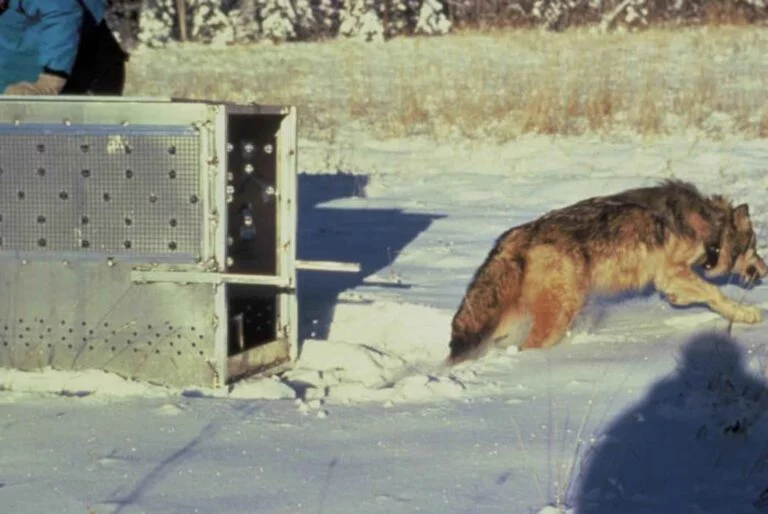


Algonquin’s public wolf howl in August is worth planning a trip around. They can’t promise the wolves will answer, but when they do you won’t forget it.
went to brooks falls for the bears and saw a wolf on the far bank. nobody else even noticed.
Lucky. Most people are only watching the bears.
Does anyone know a recent count for wolves inside Denali? I’ve seen very different figures.