
Wolves Versus Wolverines: An Analysis Of Two Land Predators
4 min read
Wolves and wolverines share the same northern forests and tundra, and they meet over the same carcasses. The internet version of that meeting is a duel. The field record is much more one sided.
They are not close relatives either, despite the name. The wolverine sits in Mustelidae, the weasel family, alongside otters, badgers and martens. The wolf is a canid. The shared syllable is a coincidence of English.
The two animals, side by side
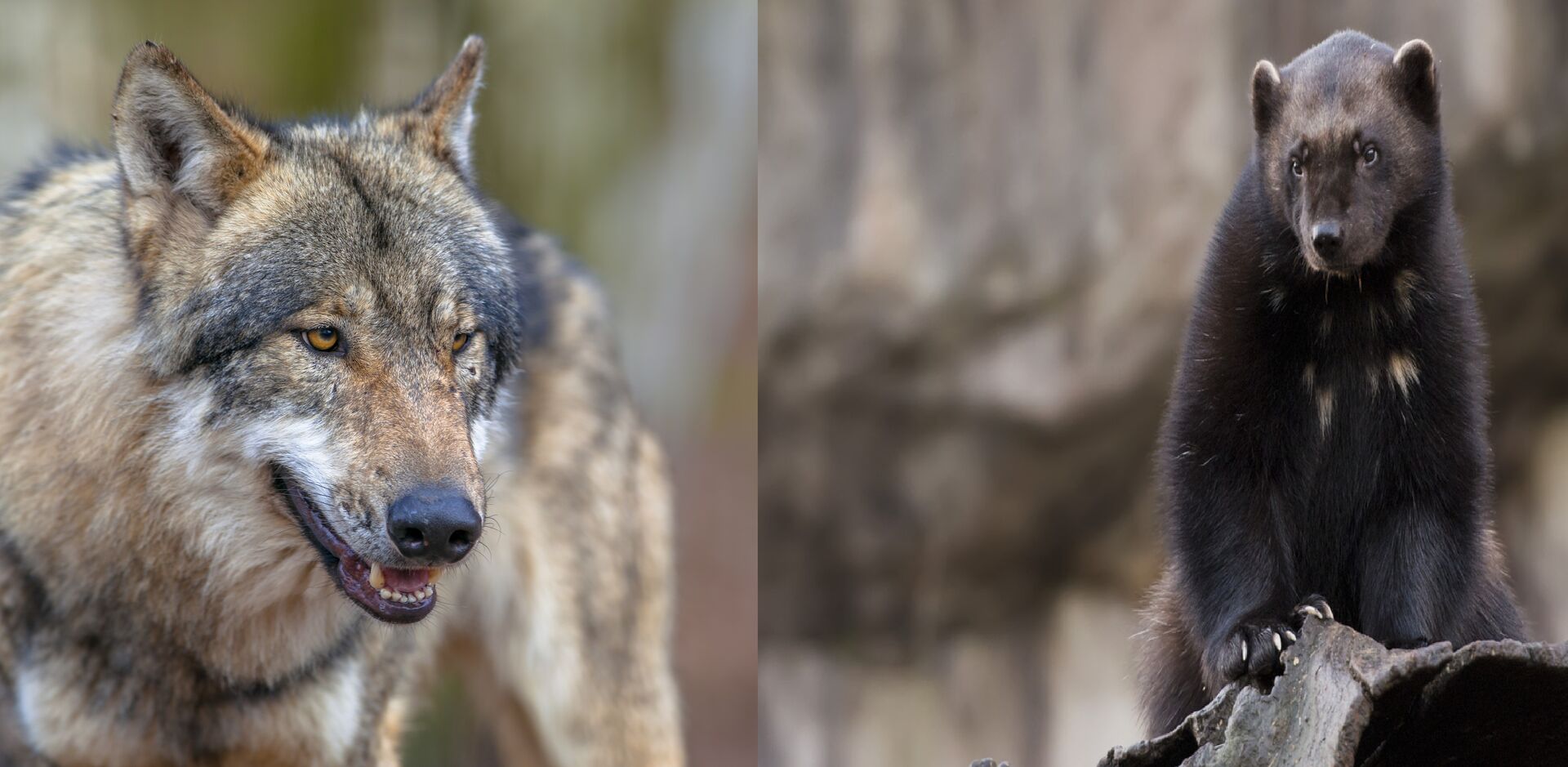
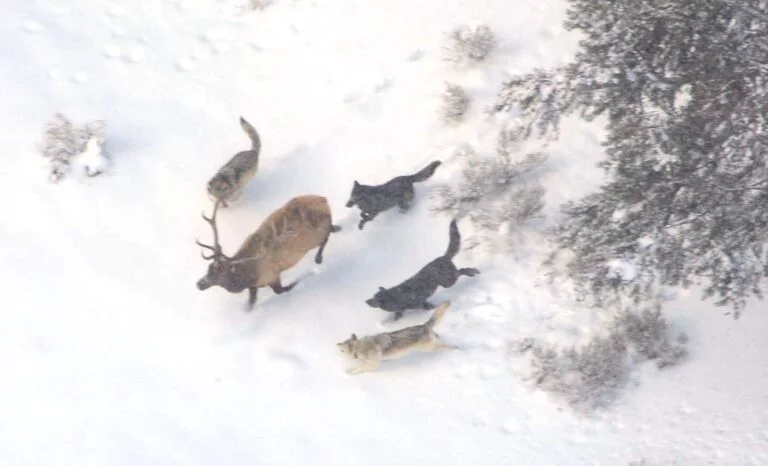
A gray wolf (Canis lupus) is the largest living member of the dog family. Body length runs roughly 105 to 160 cm, shoulder height around 66 to 81 cm, and weight commonly 25 to 40 kg depending on subspecies, with northern wolves at the heavy end. Wolves live in family packs, usually a breeding pair and their offspring, most often somewhere between five and eleven animals.
Photo by patrice schoefolt on Pexels
A wolverine (Gulo gulo) is the largest land dwelling mustelid. Body length is around 65 to 109 cm, shoulder height 36 to 45 cm, and males weigh roughly 11 to 18 kg against 8 to 12 kg for females. Exceptional 30 kg animals turn up in older Soviet literature and are generally treated as improbable. It looks like a small bear, is built almost entirely out of muscle and hide, and lives alone except to mate.
So a typical northern wolf weighs two to three times as much as a wolverine. Only the smallest wolves, such as the Indian wolf of the hot plains, overlap with the biggest male wolverines.
Where they overlap
Wolverines are boreal and Arctic animals: northern Canada, Alaska, Scandinavia, Russia. Wolves cover far more ground, from Arctic tundra down through temperate forest, mountain and steppe, with populations in North America, Europe and Asia. The overlap is the northern band, and inside that band both animals want the same thing, which is a large dead ungulate.
Photo by Leon Aschemann on Pexels
The carcass problem
Wolves are hunters. Wolverines hunt too, taking hares, rodents, ground birds and sometimes ungulates weakened or bogged down in deep snow, but a large share of a wolverine’s winter diet is scavenged. Wolf kills are the best scavenging in the north, which is why wolverines follow wolves.
That works when the pack has moved on. It does not work in a lean winter, when a pack will sit on a carcass and return to it for days. A wolverine trying to take a share from a guarded kill is the situation where the two species actually come into contact, and it is where wolverines die.
Who actually kills whom
This is the part most versions of the story get backwards. The wolf is the wolverine’s most serious predator. There is an extensive record of wolverine deaths attributed to wolves across both North America and Eurasia, from packs defending kills and from packs protecting dens.
There is no matching record in the other direction. Claims that wolverines routinely kill adult wolves, drive off whole packs, or kill polar bears circulate widely and have nothing behind them. We have found no documented case of a wolverine killing an adult polar bear, and the wolverine appears in the predator literature as prey for wolves and bears rather than as a threat to them.
None of which makes the wolverine a pushover. It has a genuinely unusual piece of anatomy: like other mustelids it carries an upper molar at the back of the jaw rotated ninety degrees inward, which lets it tear meat off carrion frozen solid. Its claws are crampon like and it climbs well. It will stand its ground against animals far larger than itself, and it wins arguments over food more often than its size suggests. But standing your ground and winning a fight are different outcomes, and against a pack the wolverine is not choosing to fight so much as trying to leave.
One on one
Individual fights between a single wolf and a single wolverine are essentially unrecorded, mostly because wolves are so rarely alone. Anyone answering the hypothetical is guessing, and the honest answer is that the size difference does most of the work: a 35 kg pack hunter against a 14 kg solitary scavenger is not a close matchup on paper. We run the same comparison for wolves versus bears and wolves versus lions.
Bite force numbers get quoted here a lot, usually as a wolf figure of 136 against a wolverine figure of around 105. Those are bite force quotients, a measure that corrects for body mass, not raw pressure. They tell you the wolverine bites hard for its size. They do not tell you it out bites a wolf, because the wolf is several times heavier.
Humans
Both animals have been trapped and hunted, wolves for fur and for livestock conflict, wolverines chiefly for their frost resistant fur, which is still prized for parka trim in the Arctic.
As a risk to people, neither ranks. Wolf attacks on humans are rare and the majority of recorded ones have involved rabid animals. Documented wolverine attacks on humans are absent from the record altogether. If you are walking in northern country, the wolverine is not what you should be thinking about, and neither, statistically, is the wolf.
Read more in our complete guide: Wolf Behavior: How Wolves Live, Hunt and Communicate.
Updated 8 October 2026: corrected the claim that every adult wolf outweighs every wolverine.




Wolverines are in the weasel family, not related to bears at all. They just look the part.
Wolverines will take on much bigger animals at a carcass. Fearless.
Makes sense. Getting hurt over scraps isn’t worth it for a wolf.
Wolverines need deep spring snow for their dens, so I’d guess warming hurts them far more than wolves.