
Do Wolves Howl at the Moon? Real Reason for Wolf Howls
5 min read
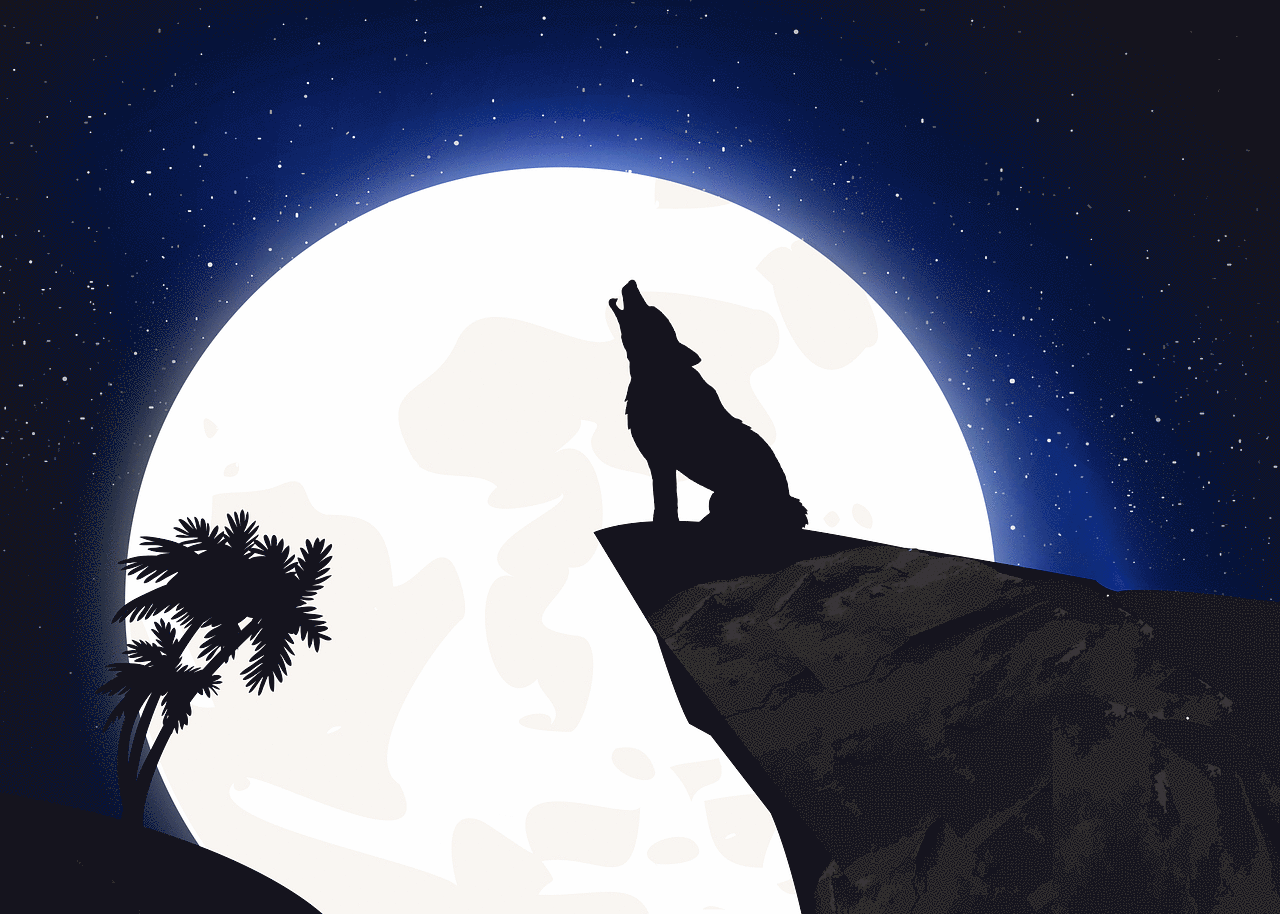
Wolves do not howl at the moon. Howling frequency tracks pack activity, not lunar phase. Wolves howl to find pack mates across long distances, to tell rival packs a territory is occupied, around hunts, and when the pack comes back together after a separation. The picture we all carry, a wolf silhouetted against a full moon, comes from the posture: a howling wolf lifts its muzzle, and an illustrator who wants a light source behind it puts the moon there.
Where the myth came from
Nobody can point to the first person who drew it, and claims about exact origins in this or that ancient civilisation tend to be invented after the fact. What is easy to show is why the image is so stable. Wolves howl with the head raised and the throat extended, which projects the sound and, incidentally, aims the muzzle at the sky. Wolves are most vocal at night. Put those two together in a single frame and the moon is the only thing available to put behind the animal. Every children’s book, film poster and tattoo since has copied the frame rather than the behaviour.
The lunar question is testable, and it has been tested. Researchers logging howling against moon phase have not found the correlation the myth predicts. What howling does correlate with is what the pack is doing: travelling, hunting, defending, regrouping.
Werewolf fiction and film, which tied a man’s change into a wolf to the full moon, then reinforced the pairing.
Long distance communication
The howl is the longest range sound a wolf makes. The National Park Service puts it at about 11 km through forest and up to 16 km across open ground. That range is the whole point. Wolf territories are large, packs split up to travel and forage, and a howl is the cheapest way to ask where everyone is.
A dispersing young wolf uses the same channel for the opposite purposes depending on what it wants: advertising itself to find a mate, or listening for resident packs so it can route around them.
The fundamental frequency of an adult howl runs from about 150 to 780 Hz (Theberge and Falls, 1967). Packs and lone wolves use the channel differently. In Minnesota, Harrington and Mech (1979) found that packs answered human howls far more often when they were at a fresh kill, and that lone wolves, which hold no territory, rarely answered at all.
Territorial advertising
A chorus howl from a pack on its own ground is a notice to the neighbours. It works the way bird song works: cheap to produce and audible a long way off. A listening pack can tell roughly how far away the callers are and decide whether to answer, approach or quietly leave.
Choruses can also make a pack sound bigger than it is. Each wolf shifts pitch as a chorus builds, and Harrington (1989) found that choruses from a single adult pair in Minnesota were hard to tell apart from those of larger packs with pups. He suggested the effect exaggerates pack size, an example of what biologists call the Beau Geste effect.
Around the hunt
Packs are noisy before and after hunting. A pre hunt chorus works as a rally. Howling after a kill helps bring in members who were elsewhere, and doubles as notice to scavengers and rival packs that the carcass is spoken for. Functions overlap constantly. One chorus can locate the pack, mark the territory and reinforce the bond between the animals doing it, all at once, which is part of why arguments about the single purpose of howling go nowhere.
Do wolves howl more at night?
Yes, and the moon has nothing to do with it. Wolves are most active around dawn, dusk and through the night, so their loudest signal lands in the same window. Cool night air also carries sound further than warm turbulent daytime air, which makes a night howl a better investment.
There is a plausible indirect route by which bright nights could matter, since moonlight changes how prey and predators move, but that is a question about activity levels rather than about wolves addressing the moon, and the howling data has not shown it.
Dialects and individual voices
Individual wolves have distinguishable voices. Work by Holly Root Gutteridge and colleagues showed that individual wolves can be identified from spectrograms of their howls with high accuracy, which is now used as a non invasive way of counting animals.
There is also variation between populations and species. Arik Kershenbaum and colleagues analysed more than 2,000 howls from 13 canid species and subspecies in a 2016 study and found that howl types cluster by group, closely enough to work as an acoustic fingerprint. Calling these dialects is a loose analogy, but the differences are measurable.
How researchers use howling
Elicitation howling is a standard survey method. A researcher howls, or plays a recording, and listens for a reply. An answer confirms a pack is present, gives a rough bearing, and sometimes lets the listener count voices in the chorus.
Algonquin Provincial Park in Ontario turned this into a public event. Douglas Pimlott’s wolf research there, from 1958 to 1965, found that the park’s wolves would answer human imitations, and the first Public Wolf Howl was held on 17 August 1963. It ran intermittently at first because of the logistics of moving hundreds of people into the dark, and continued until Ontario Parks ended the programme in August 2022.
Can we tell what wolves are saying?
Up to a point. Recordings can be sorted by pack of origin, by individual, by rough pack size and by broad context. What has not been demonstrated is anything like words: specific sounds standing for specific things. The weight of evidence says a howl carries identity, location and arousal rather than content. That is less romantic than a wolf language, and it is still a lot of information to pack into one sound.
Related reading on welovewolves
Frequently asked questions
Do wolves actually howl at the moon?
No. Studies of howling have not found a relationship between lunar phase and how much wolves howl. The association is an artefact of the raised muzzle posture and of wolves being most active after dark.
Why do wolves howl?
To locate pack mates over long distances, to advertise an occupied territory to neighbouring packs, to rally before a hunt and gather at a kill, and to reunite after a separation. One chorus often does several of those jobs at once.
How far can a wolf howl be heard?
About 11 km in forest and up to 16 km over open ground, according to the National Park Service. Cold still air carries it further than warm turbulent air.
Do wolves howl more at night?
Yes, but because that is when they are awake and moving, and because sound carries better in cool night air. Not because of the moon.
Can wolves recognise each other by voice?
Individual wolves have acoustically distinct howls, and researchers can identify known animals from spectrograms with high accuracy. Pack choruses also carry a recognisable combined signature.
Do wolves have accents?
Populations differ measurably. A 2016 analysis of more than 2,000 howls across 13 canid species and subspecies found howl types cluster by group well enough to identify them acoustically. Whether to call that an accent is a matter of taste.
Why do dogs howl at sirens?
A siren sits in roughly the same frequency band as a long howl, and dogs retain the wolf response of answering one. Whether an individual dog joins in seems to come down to breed and temperament. Plenty ignore it completely.
Last updated 27 July 2026.
Updated 8 October 2026: corrected the howl range, the date of the first Algonquin Public Wolf Howl and the status of that programme, which ended in 2022; merged our posts on the moon myth, the functions of howling and howl types into this guide; also corrected what a howling chorus tells a listening pack.



The head tilt is to send the sound further. Nothing to do with the moon.
My huskies howl at every siren. Wolves seem much more selective about it.
So it’s really just the pose? I always assumed the moon thing had at least something behind it.
evening and early morning is when i’ve heard them most. never noticed the moon making any difference.