Wolves and the Endangered Species Act
6 min read
The Endangered Species Act is the reason there are wolves in the lower 48 United States, and the reason their legal status has changed roughly every four years for two decades. This is the timeline: what the Act did, who has tried to undo it, and where the arguments are now.
Part of our guide: Wolf Conservation.
1973 to 1995: listing and recovery planning
The Act passed in 1973 and gray wolves were listed as endangered across most of the contiguous United States shortly afterwards. At that point the lower 48 population was a few hundred animals in northern Minnesota plus a small group on Isle Royale. Recovery planning identified the Northern Rockies, the western Great Lakes and the Southwest as the three zones where wolves could realistically come back.
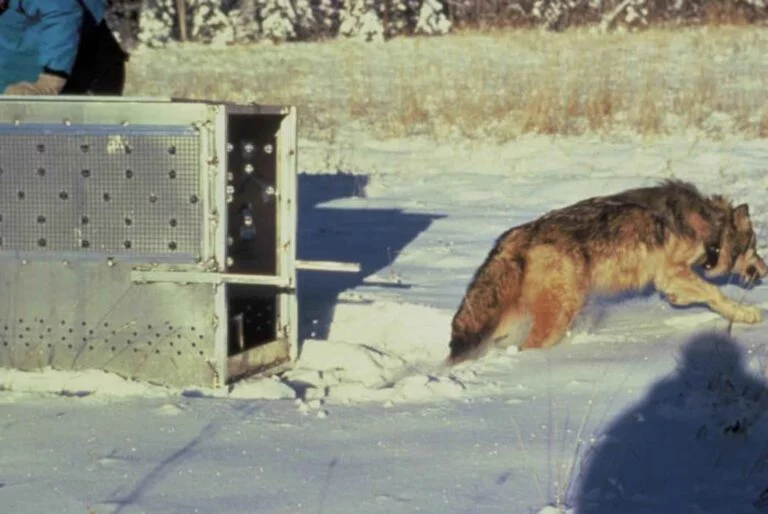
Two things followed from that framework. The red wolf, declared extinct in the wild in 1980, was reintroduced to North Carolina in 1987 under the Act’s experimental population provisions. The Mexican wolf, functionally extinct in the wild by the same period, was rebuilt from seven captive founders and released in Arizona from 1998. And in 1995 and 1996 wolves captured in Canada were released into Yellowstone and central Idaho. None of that happens without the legal architecture behind it.
2011: Congress delists the Northern Rockies
The Fish and Wildlife Service tried to delist Northern Rockies wolves in 2009 and was challenged in court. Congress resolved it in 2011 by attaching the delisting to a budget bill, which is the only time a species has been removed from the endangered list by legislation rather than by agency decision. Idaho and Montana have managed their own wolves ever since. Wyoming was left out of the 2011 rider: its wolves were delisted in 2012, put back under federal protection by a court in September 2014, and returned to state management in 2017 when an appeals court reinstated the delisting.
2020 to 2022: national delisting and reversal
The Fish and Wildlife Service finalised a nationwide delisting in 2020, removing federal protection across most of the remaining range. In February 2022 a US District Court vacated the rule, finding that the agency had not assessed wolves across their historical range and had never properly defined what a significant portion of that range means. Protection returned everywhere the 2020 rule had touched, which did not include the Northern Rockies.
Our separate article on the 2022 relisting goes through the ruling and the Wisconsin hunt that preceded it.
2024 to 2026: the latest round
In 2024 the Fish and Wildlife Service found that gray wolves in the western United States did not need federal protection. On 5 August 2025 US District Judge Donald Molloy in Montana set aside most of that finding and sent it back to the agency. The ruling did not end state management in the Northern Rockies.
Congress moved the other way. On 18 December 2025 the House passed H.R. 845 by 211 votes to 204. The bill would remove the gray wolf from the endangered list nationwide and bar court challenges to that decision. On 4 August 2026 Senator Cory Booker blocked a request to pass the Senate version, S. 1306, by unanimous consent.
On 4 September 2026 a presidential executive order gave the Interior Secretary 90 days to decide whether the Mexican wolf qualifies for delisting or downlisting, and asked for a recommendation to Congress on delisting wolves. The order did not change the legal status of any wolf.
What states do after delisting
Delisting hands wolves to the states, and their rules differ sharply. Montana and Idaho widened hunting and trapping after taking over. Wyoming classes wolves as predators across about 85 percent of the state, where they can be killed without a licence. Washington and California list wolves as endangered under state law, while Oregon removed them from its state list in 2015. Our page on wolves of the Pacific Northwest covers those three states.
Wisconsin shows how fast a state season can move. After the 2020 national delisting took effect, a court ordered a hunt at short notice in February 2021. Hunters killed 218 wolves in under three days, against a state quota of 119, before the season closed. More on that population is in our guide to Great Lakes wolves.
2021 to 2026: the Northern Rockies petitions
After Idaho and Montana passed laws in 2021 to cut their wolf numbers, conservation groups asked the Fish and Wildlife Service to list wolves again, either in the Northern Rockies or across the western United States. The Center for Biological Diversity, the Humane Society of the United States and the Sierra Club filed in June 2021, and Western Watersheds Project and 70 other groups followed in July. In September 2021 the Service found that listing might be warranted and opened a full status review.
On 7 February 2024 the Service published its finding that listing was not warranted. It counted 2,797 wolves in at least 286 packs across seven western states at the end of 2022, and treated the Northern Rockies wolves as part of one larger western population. Wolves in Idaho, Montana and Wyoming stayed under state management. Alongside the finding, the Service promised the first national gray wolf recovery plan by December 2025.
Neither part held. On 5 August 2025 Judge Donald Molloy of the federal court in Missoula ruled that the 2024 finding broke the Act. He found that the Service had not considered the wolf’s historic range across the West, had relied on state promises to stop killing wolves at set thresholds, and had not accounted for illegal killing. He ordered a new decision. Hunting groups appealed to the Ninth Circuit, and state hunting and trapping seasons went ahead. In November 2025 the Service dropped the national recovery plan, saying the listed gray wolves no longer needed one.
Congress is pushing the other way. On 18 December 2025 the House passed the Pet and Livestock Protection Act (H.R. 845) by 211 votes to 204. It would remove federal protection from gray wolves in the 44 states where they are still listed and aims to block court challenges to that decision. In August 2026 an attempt to pass the Senate version without a recorded vote was blocked.
Why it keeps moving
Three structural reasons, none of which is about wolf biology.
First, the Act asks whether a species is threatened across a significant portion of its range, and nobody has ever agreed on what that phrase means. Every delisting attempt has foundered on it. Second, listing decisions are made by an agency that changes political direction with each administration, and reversed by courts on a slower cycle, so the two processes are permanently out of step. Third, delisting hands management to states with sharply different politics, so the practical consequence of a federal decision varies from a hunting season to nothing at all depending on which side of a state line an animal is standing.
In Idaho, for example, the state is cutting its wolf population toward a goal of about 500. Our guide to Idaho’s wolf population has the numbers.
What the Act still covers
The red wolf and the Mexican wolf are listed separately from the gray wolf and their status has been far more stable. Both are also entirely dependent on active management: captive breeding, releases, cross-fostering of pups, and in the red wolf’s case constant work to keep coyotes out of the gene pool. Neither would exist in the wild without the Act, and neither would survive if the programmes stopped tomorrow.
Related reading
Books and prints are in the We Love Wolves store.
Frequently asked questions
Are wolves currently protected in the United States?
In most of the lower 48, yes, following the February 2022 ruling. Not in Idaho and Montana, under state management since the 2011 Congressional delisting, or in Wyoming, under state management since 2017. Alaska’s wolves have never been federally listed.
Has Congress ever delisted another species this way?
The 2011 Northern Rockies wolf rider is the case people cite as the exception, and it remains the standard example of legislative rather than scientific delisting.
Why is Minnesota listed differently?
Because its wolves never came close to disappearing. Minnesota has long carried a Threatened designation while the rest of the listed range carried Endangered, and that distinction survived the 2022 ruling.
Updated 8 October 2026: corrected the Wyoming history and added the 2025 to 2026 court ruling, House vote, Senate block and executive order; merged our post on wolf conservation after delisting into this guide; added the 2021 to 2026 Northern Rockies petitions, the February 2024 federal finding, the August 2025 court ruling and the December 2025 House delisting bill.