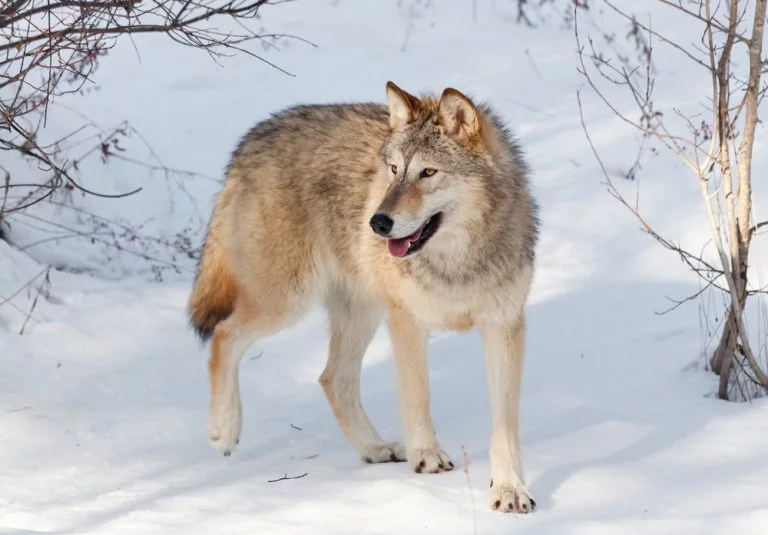
Wolves of the Great Lakes Region
3 min read
The western Great Lakes hold the largest wolf population in the contiguous United States, and unlike Yellowstone it was never reintroduced. Nobody trucked these wolves anywhere. They walked, from a remnant that survived in northern Minnesota when every other state had been cleared.
Part of our guide: Wolf Conservation.
The refuge that was never quite empty
By the middle of the twentieth century wolves had been shot, trapped and poisoned out of the lower 48 with two exceptions. A few hundred held on in the boreal forest of northern Minnesota, in and around what is now the Boundary Waters Canoe Area Wilderness. A separate handful lived on Isle Royale, the island in Lake Superior that belongs to Michigan, descended from wolves that had crossed winter ice from Ontario in the late 1940s. Accounts that say Minnesota was the only survivor quietly drop the island, which happens to be the site of the longest running predator and prey study anywhere.
Federal protection, then spread
Federal listing in 1974 stopped the killing, and the Minnesota population grew and then pushed outward. Wolves were breeding in Wisconsin again from the late 1970s and were re-established across Michigan’s Upper Peninsula by the early 1990s. Every wolf in the region traces back to that Minnesota remnant plus dispersers arriving from Ontario. Some disperse much further: a wolf shot in Otsego County, New York, in December 2021 had almost entirely Great Lakes ancestry.
Where the numbers stand
Minnesota’s survey for winter 2024 to 2025 estimated 2,294 wolves in about 463 packs. Wisconsin estimated 1,162 wolves in about 321 packs in 2026, and Michigan’s 2026 winter track survey found at least 792 in the Upper Peninsula. Add them up and you get roughly 4,250, but the three surveys come from different winters and measure different things: Michigan’s is a minimum, and Wisconsin’s counts only wolves in packs. Anyone giving you one confident number for the whole region is rounding three separate surveys.
For Michigan survey by survey since 1989, with each count linked to its DNR report, see our Michigan wolf count history.
Stable biology, unstable law
The federal listing status of Great Lakes wolves has been delisted and relisted repeatedly through court challenges, and hunting and trapping seasons have opened and closed alongside it. This region is usually where each new federal decision is tested first. In December 2025 the US House passed a bill to delist gray wolves across the lower 48, which has not passed the Senate, and a September 2026 executive order gave the Interior Department 90 days to decide whether wolves meet recovery criteria. As of November 2026, Great Lakes wolves remain federally listed. The population itself has been comparatively steady through all of it. The legal status has not.
What are they, taxonomically?
An open question. Genetic work indicates that some Great Lakes wolves carry eastern wolf and coyote ancestry alongside gray wolf, which is awkward for a legal system that protects named species. The science is unsettled and the courts have had to rule anyway.
Related reading
For wolf-themed apparel and gifts, see the We Love Wolves store.
Frequently asked questions
How many wolves are in Minnesota?
About 2,294 in the Minnesota DNR estimate for winter 2024 to 2025, the largest of any state outside Alaska.
Did wolves survive anywhere else in the lower 48?
Northern Minnesota held the only surviving breeding population. By the 1970s the only other breeding wolves in the lower 48 were on Isle Royale in Lake Superior, and they were newcomers from Ontario that crossed the ice in the late 1940s. Everywhere else in the contiguous states had to be recolonised or reintroduced.
Are Great Lakes wolves a separate species?
Unresolved. Some carry eastern wolf and coyote ancestry. The taxonomy is genuinely debated rather than settled and quietly ignored.
Updated 8 October 2026: added dated population estimates for Minnesota, Wisconsin and Michigan, corrected the origin of the Isle Royale wolves, and added the 2025 and 2026 federal delisting moves. Updated 10 November 2026: linked each state estimate to its source and added the Michigan count history.