
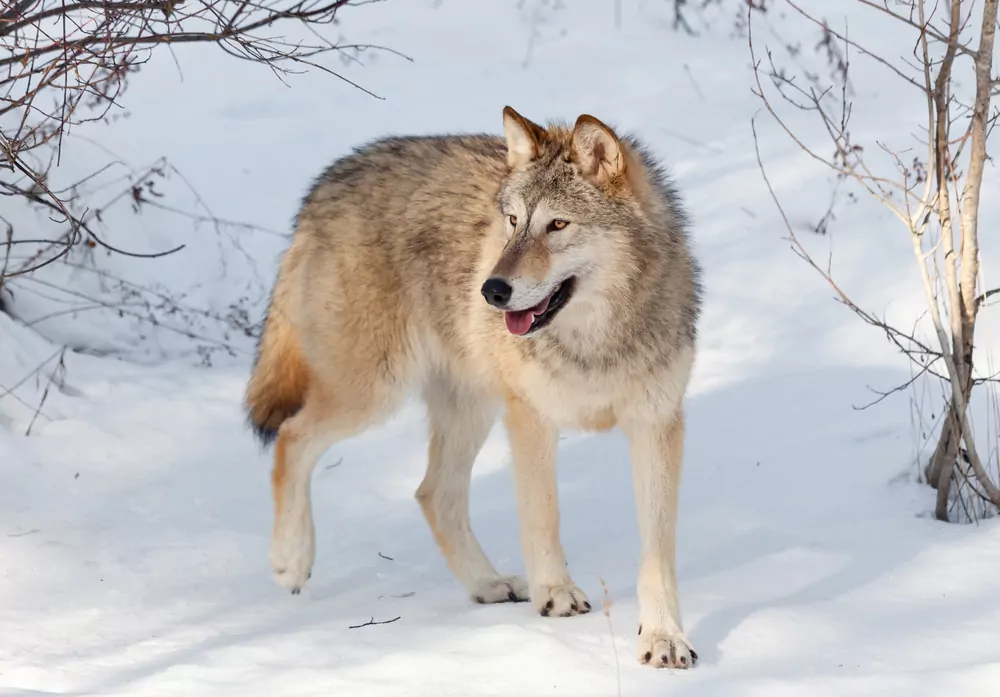
Wolves Return to Denmark After 200 Years of Absence
3 min read
Denmark had no wolves for two centuries and now has them again, without anyone releasing a single animal. The last Danish wolf was shot in 1813. A wolf turned up in Jutland in 2012, and in 2017 a pair produced the first Danish wolf pups in over 200 years. Every one of them walked in from Germany.
1813, and then nothing
The last documented Danish wolf was shot in central Jutland in 1813, at the end of centuries of continuous hunting that had already reduced the population to a remnant. That shot closed out a wolf presence in Denmark going back thousands of years, and for the next two hundred years the country had none.
What changed was Germany. Wolves recolonised the Lausitz region of eastern Saxony from western Poland in the late 1990s, bred there from 2000, and spread west and north. Getting from Lausitz to Jutland means crossing the German border through fairly densely settled country, which is why it took the best part of another decade. The first confirmed Danish wolf in 200 years appeared in Thy in north Jutland in 2012.
The 2017 pups
More animals followed the first, and in 2017 a pair in central Jutland produced pups: the first born in Denmark since 1813. Danish wolf monitoring is run through Aarhus University and the Natural History Museum in Aarhus, and it leans almost entirely on camera traps and DNA from scat and hair rather than on sightings. Genetic work traced the founders back to the eastern German population, as expected.
Danish wolves eat mostly red and roe deer, which are abundant in the Jutland forest mosaic. There is no distinct Danish wolf: these are eastern European gray wolves (Canis lupus lupus) and the Danish group is a satellite of the much larger German and Polish population, with animals moving back and forth across the border.
Where they live
Jutland, and specifically the bigger state forest blocks, which the wolves use as core areas before crossing farmland at night. Denmark is not classic wolf habitat: it is mostly agriculture with small woods stitched through it, so territories here have to be larger than in the forested parts of Europe to hold enough cover and prey. Lone wandering animals turn up well outside the core, occasionally on the islands, but Jutland is where the packs are.
The politics
Support splits along the lines you would guess: broadly positive in the cities, divided in rural Jutland, largely hostile among sheep farmers inside the wolf range. Wolves are protected in Denmark, and the state pays compensation for verified livestock losses along with subsidies for electric fencing and other non-lethal deterrents. Uptake of the deterrents is uneven, which is the usual pattern: farms that invest heavily report almost no losses, farms that keep sheep out on open pasture take periodic hits and claim.
The flashpoint was an illegal shooting in April 2018. A man shot a wolf from a vehicle in Jutland, video of it circulated, and he was prosecuted and convicted under the protections that apply to the species. The case is still cited by both sides of the Danish wolf argument.
What happens next
Slow growth, constrained by patchy habitat, road mortality on a dense road network, and a small number of suspected illegal killings each year that mostly go unsolved. As the German and Polish populations keep expanding, Denmark will keep receiving dispersers, and the genetic isolation problem that troubles Scandinavian wolves does not really apply here. The biological question was settled the moment the 2017 pups survived. The political one has not been.
The national monitoring, run by Aarhus University and the Natural History Museum Aarhus, counts territories and litters rather than individual wolves. Its preliminary count for 2026 recorded at least 61 pups in 11 territories, up from 45 pups in seven litters in 2025.
Related reading on welovewolves
- Gray wolf species profile
- Who is afraid of German wolves?
- Wolves and livestock conflict
- Non lethal wolf control
Frequently asked questions
When did wolves return to Denmark?
A wolf was confirmed in Thy, north Jutland, in 2012, the first in the country for two hundred years. Breeding followed in 2017.
Where did they come from?
They walked. Danish wolves are dispersers out of the eastern German population that established in Lausitz from the late 1990s. Nobody released anything.
Are Danish wolves a danger to people?
There have been no attacks on people since the return. The one violent incident on record ran the other way, when a man shot a wolf in 2018 and was convicted for it.
Can I see one?
Realistically, no. Monitoring here runs on camera traps and DNA precisely because sightings are so rare. Skandinavisk Dyrepark in Djursland keeps a captive pack that is visible year round.
Updated 8 October 2026: added the 2026 litter count from the Danish national monitoring.



Wolves don’t read maps. Funny how surprised everyone was.
Hunters should be glad, in theory. Wolves take a lot of the weak and sick animals.
About two hundred years between the last Danish wolf and the next one. That’s a long gap.
There may have been a few wanderers in between that nobody recorded. Still a long time.