
African Golden Wolf: New Species, Old Mystery, Full Profile
5 min read
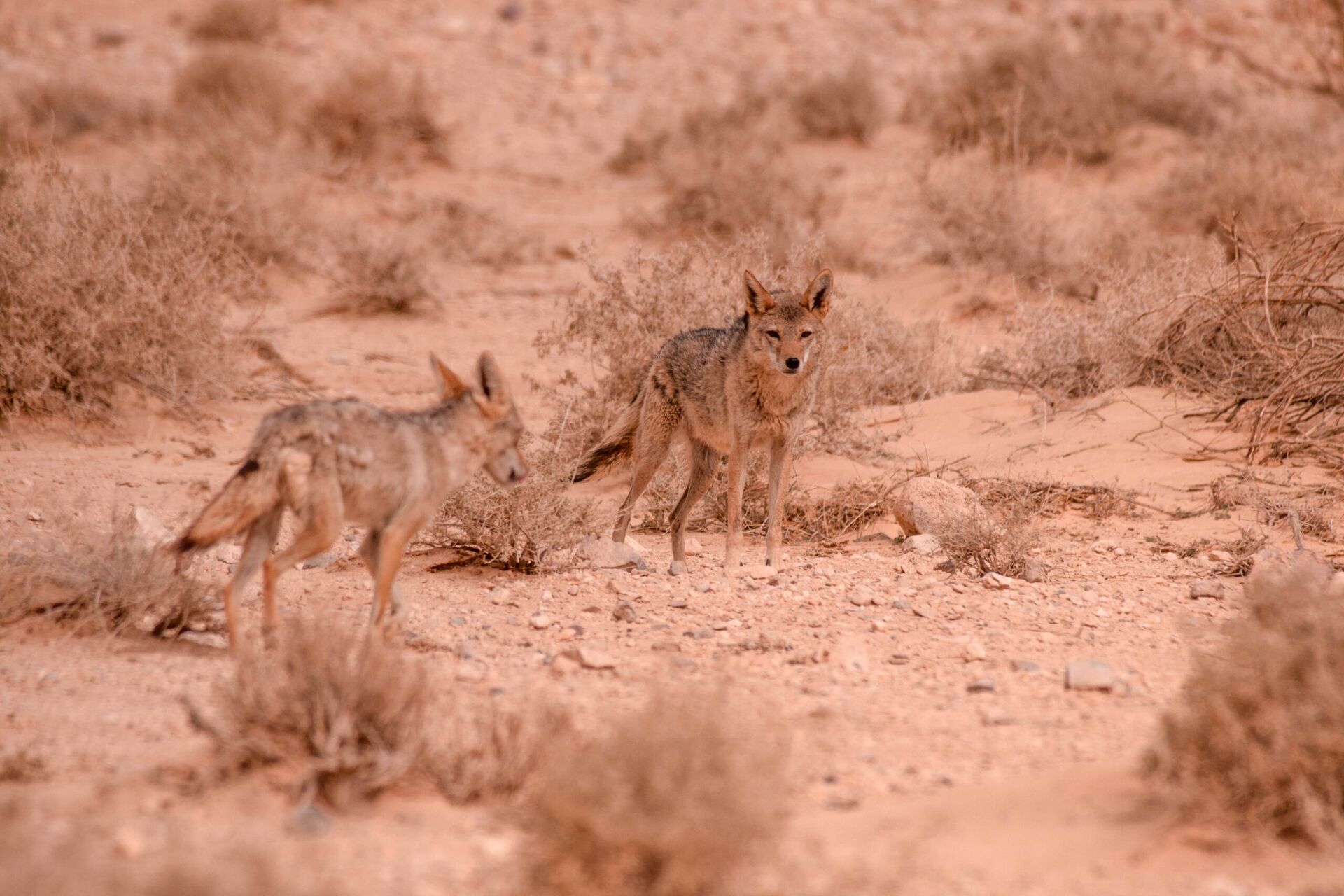
The African golden wolf (Canis lupaster) is a slender, sandy coloured canid found across North and East Africa. Until 2015 it was filed as a population of golden jackal. Genome work showed the African and Eurasian golden lineages had been separate for around a million years, and the African animal turned out to sit with the gray wolf rather than with the jackals it had been named after.
Key facts at a glance
| Common name | African golden wolf (formerly African golden jackal) |
| Scientific name | Canis lupaster |
| Family | Canidae |
| Shoulder height | 40 to 50 cm |
| Body length | 60 to 100 cm |
| Weight | 7 to 15 kg |
| Diet | Small mammals, ground birds, hares, lizards, carrion, fruit |
| Habitat | Semi-desert, savanna, scrubland, farmland margins, sea level to 3,800 m |
| Group size | Mostly pairs, sometimes family groups of 4 to 7 |
| Lifespan | Around 8 years in the wild |
| IUCN status | Least Concern |
| Range | North Africa from Senegal east to Egypt, south to Kenya and northern Tanzania |
The 2015 reclassification
For most of the twentieth century the golden jackal (Canis aureus) was treated as one species running from Senegal through North Africa and the Middle East and across much of Eurasia. In 2015 a study led by Klaus-Peter Koepfli at the Smithsonian, published in Current Biology, compared mitochondrial and nuclear DNA from African and Eurasian populations. The lineages had diverged over a million years earlier with no recent gene flow. The African population was separated out, initially under the name Canis anthus and now generally as Canis lupaster, which is why older captions and museum labels use both.
What makes the case unusual is that nothing new was found in the field. The animal had been in museum collections for two centuries. It looked slightly larger than its Eurasian counterpart, and that difference sat comfortably inside normal population variation, so nobody pushed it. The genome data settled what morphology could not.
Identification
Smaller than a gray wolf, slightly larger than a Eurasian golden jackal. Adults run 7 to 15 kg at a shoulder height of 40 to 50 cm. The coat is warm sandy gold to yellowish brown with darker grizzling along the back, a black-tipped tail, and a pale chest and belly. North African animals tend darker, East African animals paler.
In the field the likeliest confusion is with a medium-sized domestic dog, and in the Ethiopian highlands with the Ethiopian wolf, which is reddish rather than golden and far rarer. Against the smaller desert foxes it shares range with, the golden wolf is larger, longer legged and carries its tail straight rather than curled.
Range and habitat
The species runs across North Africa from Senegal in the west to Egypt in the east, and south through the Horn of Africa to northern Tanzania. The two largest concentrations are the Maghreb and East Africa. Altitude range is extreme for a canid, from the Nile delta at sea level to over 3,800 m in the Ethiopian highlands.
They are habitat generalists, at home in semi-desert, savanna, scrubland, farmland and the edges of towns and cities. They are one of the few medium-sized African carnivores whose range has grown in the modern era, and they have been recorded scavenging in the outskirts of large cities.
Diet and hunting
Opportunistic omnivores. The diet leans on small mammals (gerbils, rats, hares, hyrax), topped up with ground-nesting birds and eggs, lizards, large insects, carrion from bigger predators, fruit and human food waste. In the Serengeti they shadow lion and hyena kills and take the remains.
Hunting is solitary or in pairs. A bonded pair will often work together at dawn and dusk, one flushing prey towards the other. Pups are weaned at around three months and start joining hunts at about six.
Social life and reproduction
The basic unit is a long-term breeding pair. Family groups of four to seven, including grown offspring, form where prey density allows. Pairs share territory, scent mark together and see off intruders. The voice is a high yip-howl, nothing like a gray wolf’s chest howl, often delivered in chorus.
Mating runs October to February with births December to April after a gestation of about 63 days. Litters are large for a small canid, typically four to seven. Dens are dug into sandy banks or taken over from aardvarks and porcupines, and older offspring help feed the pups.
Threats and conservation
Least Concern on the IUCN Red List, with a large continental population and an expanding range. Local pressures are real enough: road mortality, poisoning by farmers protecting poultry, hybridisation with feral dogs in heavily settled areas, and rabies and canine distemper outbreaks.
The species is unprotected across most of its range and is treated as a fur-bearing game animal in parts of North Africa. In Ethiopia it benefits incidentally from Ethiopian wolf conservation work in the same protected areas.
Anubis and the folklore
The jackal-headed gods of ancient Egypt may not have been modelled on jackals. Since the 2015 genetic study, some writers have suggested the golden wolf fits Anubis better, though no study of the statues settles it. Wepwawet, the god of Asyut, which the Greeks called Lycopolis, was linked to a wolf from the start.
Across the Maghreb the species appears in Berber and Arab folklore as the trickster, often paired against the lion. In the Horn of Africa it is a marginal figure, well behind the hyena and the lion.
How to see one
The Serengeti and Ngorongoro ecosystem in Tanzania and Kenya is the easiest place by a wide margin. The animals are habituated to vehicles and visible on the open plains at dawn and dusk, and the Maasai Mara produces sightings reliably. Bale and Simien in Ethiopia hold smaller numbers, often seen on the same trips as Ethiopian wolves.
North Africa is the paradox: the species is common and hard to see. High human density has made them wary and mostly nocturnal, so sightings tend to come on dedicated trips into desert margins such as Jebil in Tunisia or Souss-Massa in Morocco.
Related reading on welovewolves
- Gray wolf species profile
- Ethiopian wolf species profile
- Indian wolf species profile
- Wild creatures in the same family as wolves
- Wolf tourism worldwide
Authority sources
- IUCN Red List: African wolf
- Koepfli et al 2015, Current Biology
- Animal Diversity Web: African golden wolf
Frequently asked questions
Is the African golden wolf a real species?
Yes, recognised since 2015. The Koepfli genome study showed the African population had been separate from the Eurasian golden jackal for over a million years. It is now Canis lupaster, closer to the gray wolf than to the jackal it was named after.
What does it eat?
Mostly small mammals, plus ground birds and eggs, lizards, large insects, carrion from lion and hyena kills, fruit and human food waste.
Where do African golden wolves live?
From Senegal east to Egypt and south through the Horn of Africa to northern Tanzania, from sea level to over 3,800 m, in semi-desert, savanna, scrubland, farmland and city margins.
Is it endangered?
No. Least Concern, with an expanding range. Local threats are road mortality, poisoning, hybridisation with feral dogs and disease.
Was Anubis an African golden wolf?
Possibly. Since the 2015 genetic split, some writers have suggested the golden wolf fits Anubis better than a jackal, but no study of the statues settles it.
Are they dangerous?
No documented attacks on people. They are far smaller than a gray wolf and live mostly on rodents. Poultry losses are the usual source of conflict.
Where can I see one?
The Serengeti and Ngorongoro ecosystem, or the Maasai Mara. Bale Mountains National Park in Ethiopia holds smaller numbers alongside the Ethiopian wolves.
Updated 8 October 2026: corrected the Anubis and Wepwawet section, which overstated the evidence.


they look so much like jackals it’s no surprise they were filed under the wrong species for so long.
The 2015 genetic study was a real surprise. I’d always thought of them as jackals.
Some papers now call it Canis lupaster rather than Canis anthus. I’m not sure the naming has settled.
I’ve seen both used. Seems to depend on the author.