
Caspian Sea Wolf: The Lean Wolf of the Steppe, Full Profile
4 min read
The Caspian Sea wolf (Canis lupus campestris), usually called the steppe wolf, is a pale, long-legged gray wolf of the Caspian basin, the central Asian steppes, the Iranian plateau and parts of the Caucasus. It is also one of the least studied wolf populations anywhere, and that lack of study is the single most important thing to understand about it.
Key facts at a glance
| Common name | Caspian Sea wolf, steppe wolf |
| Scientific name | Canis lupus campestris (Dwigubski, 1804) |
| Family | Canidae |
| Shoulder height | 65 to 80 cm |
| Weight | Around 35 to 40 kg, somewhat smaller than the Eurasian wolf |
| Diet | Saiga, wild boar, goitered gazelle, hare, rodents, livestock |
| Habitat | Semi-arid steppe, desert margin, mountain valleys |
| Pack size | 5 to 10 |
| IUCN status | Least Concern, as part of Canis lupus |
| Range | Caspian basin, Caucasus steppe, lower Volga, southern Kazakhstan north to the middle Emba, Iranian plateau |
Identification
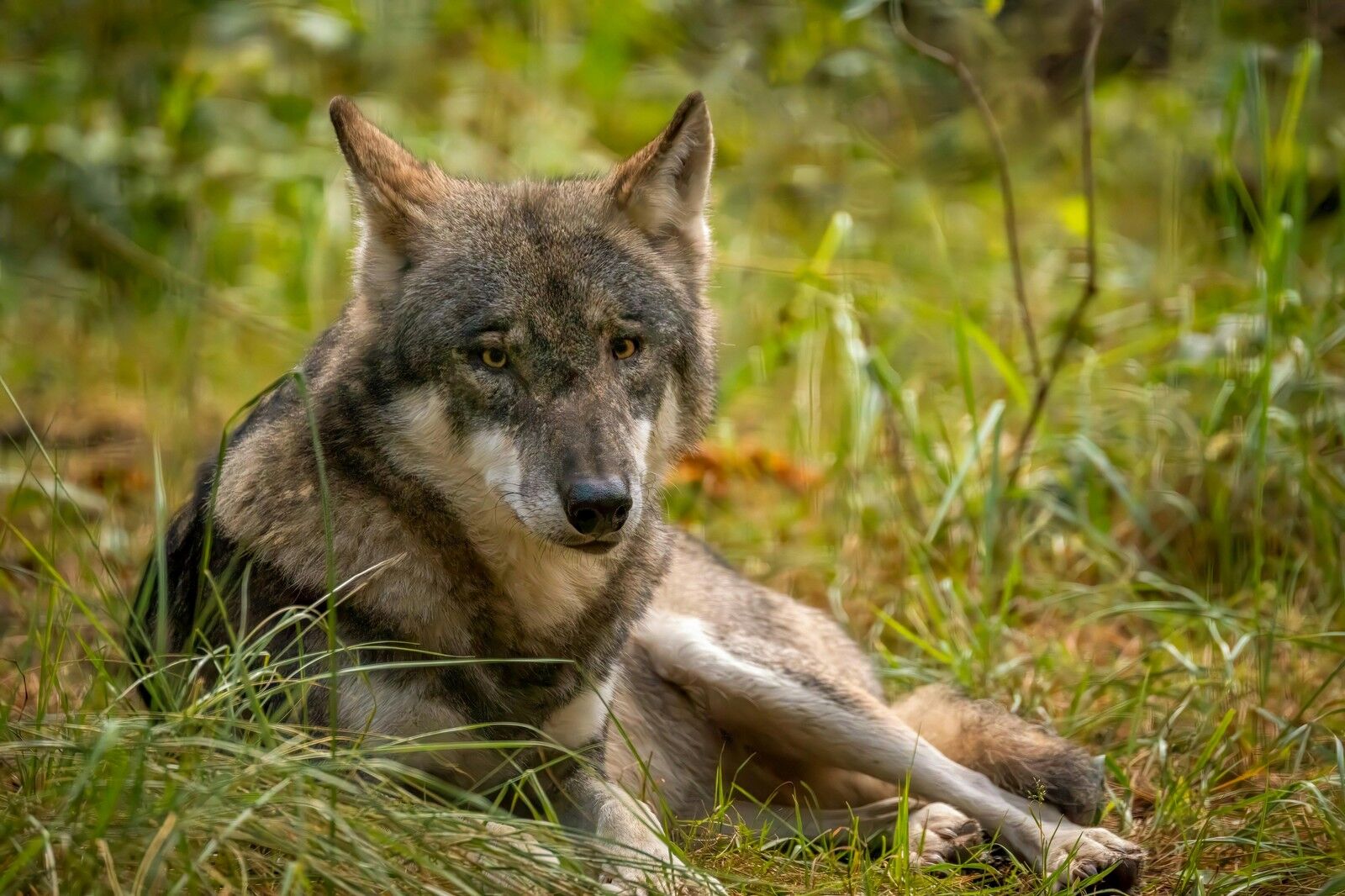
Steppe wolves are leaner and more lightly built than the Eurasian wolf of the boreal forest, and a bit smaller: usually put at around 35 to 40 kg. The coat is short and coarse over a pale sandy or yellowish-grey base, darker grizzling along the back, cream underneath. The muzzle is long and narrow, the legs are unusually long for the body, and the paws are smaller than a northern wolf’s, which is what firm ground selects for.
Subspecific status is debated. Some authors fold campestris back into Canis lupus; others keep it as a recognisable desert and steppe ecotype. The description dates to Dwigubski in 1804, which tells you how long the label has been in use and how little has been done with it since.
Range and habitat
The range runs from the steppes around the Caspian and the Caucasus east through the lower Volga and southern Kazakhstan as far north as the middle Emba, with the southern edge reaching across the Iranian plateau and into northern Afghanistan. Northward it blends into the broader Eurasian wolf range across the Russian forest steppe.
Habitat is semi-arid open steppe, desert margin and mountain valley. Steppe wolves rarely use dense forest. In low prey density areas home ranges can exceed 1,000 square kilometres.
Diet and hunting
Saiga antelope is the iconic wild prey of the central Asian steppes, though the saiga’s own crashes have pushed wolf diets toward smaller animals. Wild boar, goitered gazelle, hare, ground squirrels and rodents fill most of the rest, with wild sheep and goats taken in mountain valleys. Predation on sheep, goats, camels and the occasional foal is widespread and is the source of nearly all the human conflict.
Hunts on open ground mean long pursuits, which is what the build is for. Solo hunting on hares and rodents is common in summer. Packs run about five to ten and get smaller in winter when food is short.
Pack life and reproduction
Structure matches gray wolves everywhere else: a breeding pair plus offspring from the last one to three years. Mating runs February into March, pups arrive April to May, litters average five or six. Dens go into riverbanks or under rocky outcrops and often get reused across years. Most mortality is from hunting, with vehicle strikes and rabies behind it.
Hunting pressure and the saiga collapse
Direct hunting is the biggest pressure on this population. Wolves are hunted year round across most of the range, and Russia and Kazakhstan have long paid bounties for them.
The second pressure is the prey base. In May 2015 more than 200,000 saiga died in central Kazakhstan inside about three weeks, a Pasteurella infection triggered by unusually warm humid spring weather. Saiga have recovered substantially since, but the shock pushed wolves toward livestock and small mammals and the conflict picture has not fully reset.
Cultural context
Wolves sit near the centre of Kazakh, Kyrgyz, Turkmen and Mongolian tradition. Asena, the mother wolf of Turkic origin myth, appears in the Gokturk foundation stories. Wolf imagery runs through Kazakh and Kyrgyz decoration and through central Asian heraldry.
The hunting tradition is its own cultural artefact. Pre-Soviet Kazakh and Kyrgyz wolf hunting used trained golden eagles to drive wolves toward mounted hunters. The Soviet bounty system industrialised what had been a horseback pursuit, and the post-Soviet period saw bounties weaken in some range states and harden in others.
What we do not know
We do not have a population figure for the steppe wolf that we would put our name to. Numbers get quoted for Kazakhstan and for the range as a whole, and we have not been able to trace them to a survey. There is no coordinated census across the range, the political geography makes one unlikely, and the subspecies has no protected status anywhere in it.
If you work on central Asian carnivores or know of a published survey, leave a comment. We would rather print a sourced number than a confident one.
Conservation outlook
Listed Least Concern under the IUCN as part of Canis lupus. Russian and Kazakhstani national assessments treat it as a game animal with no protection. International interest has been thin because the global gray wolf population is healthy and nobody is legally obliged to act.
The useful conservation work here is indirect: saiga recovery. The Saiga Conservation Alliance and Fauna and Flora International have run programmes since 2007 on anti-poaching and population rebuilding. Every saiga is a wolf meal that is not somebody’s sheep.
Related reading on welovewolves
- Gray wolf species profile
- Who will save the Russian wolves?
- Wolves and poisoning
- Wolves and livestock conflict
- Wolf tourism worldwide
Frequently asked questions
Is the Caspian Sea wolf a real subspecies?
It is recognised as Canis lupus campestris by most modern treatments, described by Dwigubski in 1804, though some authors merge it back into Canis lupus. It is at minimum a distinct steppe and desert ecotype.
Where do they live?
The steppes around the Caspian and the Caucasus, the lower Volga, southern Kazakhstan north to the middle Emba, and south across the Iranian plateau into northern Afghanistan.
How many are there?
Nobody knows. There is no range-wide census and we have not found a national survey we can cite. Treat any specific figure you see with caution, including ones quoted confidently elsewhere.
Are they endangered?
No, they are Least Concern as part of the wider gray wolf listing. Russia and Kazakhstan both run culls and bounties. The steppe ecosystem itself is in worse shape than the wolf is.
Why are they called steppe wolves?
Because they live on the treeless semi-arid grassland of central Asia and are built for it: long legs, lean frame, short coarse coat, small paws. Campestris means of the plains.
Updated 8 October 2026: removed hunting figures we could not trace to a source.



Some Russian regions still pay bounties on wolves. Hard to know how many of these are left when nobody is really counting.
the sandy colour makes sense for the steppe. from a distance they could pass for a jackal.
Does anyone know why the size gap between males and females varies so much between wolf populations?
no idea honestly. prey size maybe? would love to see a study on it.