
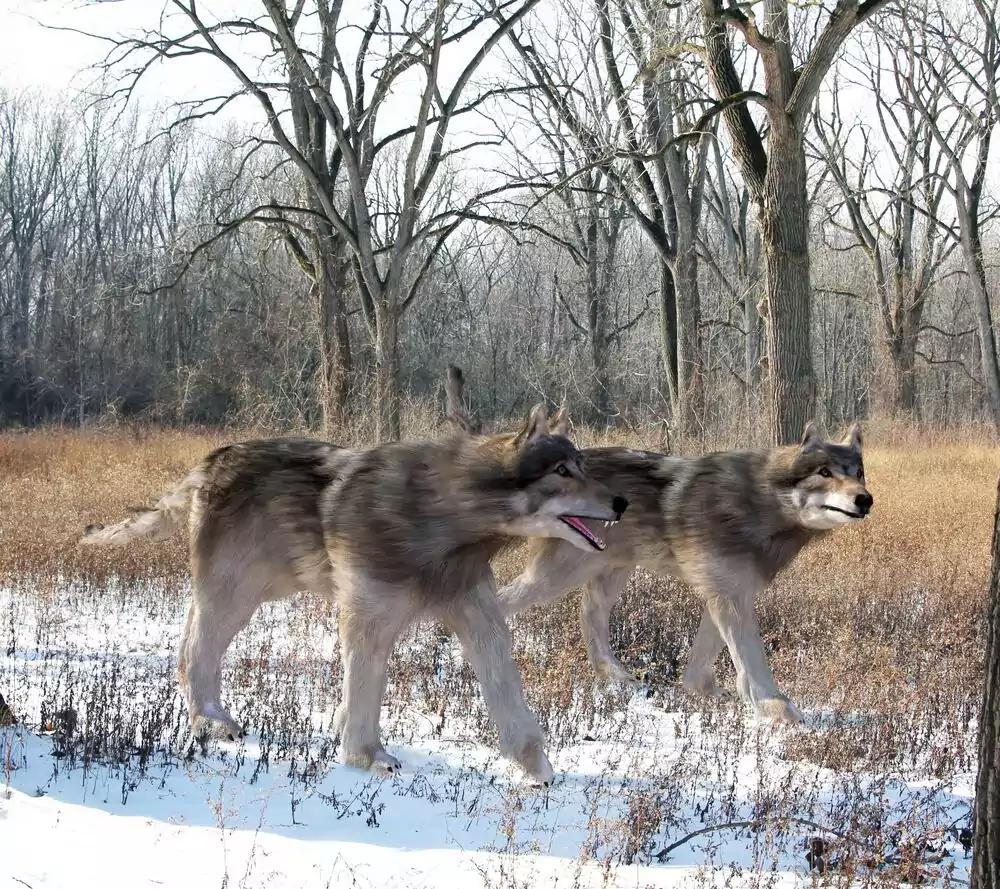
Dire Wolves: Everything We Know About the Extinct Predator
5 min read
Dire wolves (Aenocyon dirus) were real, large North American canid predators of the Pleistocene. The 2021 Nature paper by Perri and colleagues showed they were not closely related to gray wolves at all: they sat on a deep canid branch that split from the wolf and coyote line about 5.7 million years ago.
Yes, dire wolves were real
Aenocyon dirus, until recently classified as Canis dirus, is one of the best documented Pleistocene predators in North America. Dated remains run to roughly 10,000 years ago, and the species disappeared during the same wave of extinctions that took the mammoths, the ground sloths, the American horse and Smilodon.
Two subspecies are recognised. Aenocyon dirus guildayi is the shorter limbed form known from California and Mexico. Aenocyon dirus dirus, longer limbed and slightly heavier, is found east of the Continental Divide. The species also ranged into South America.
How big was a dire wolf?
Photo by patrice schoefolt on Pexels
Average body mass came out at about 60 kg for guildayi and about 68 kg for dirus. Set that against a modern gray wolf averaging roughly 43 kg for males and 37 kg for females and the dire wolf was substantially heavier, on the order of half again as much, not the modest margin the comparison usually gets given.
It was also built differently: shorter and heavier in the leg than a gray wolf, with a broader skull and proportionally larger teeth, particularly the carnassials and canines. That build is not the long distance endurance frame gray wolves run on, which is the basis for thinking dire wolves worked at shorter range. How fast either animal could actually run is not something the fossil record settles, and figures you see quoted for dire wolf chase speed are modelled guesses rather than measurements.
The 2021 Nature paper that changed the story
Before 2021 the dire wolf was generally treated as a close sister species to the gray wolf, sharing a fairly recent ancestor. Perri and colleagues extracted ancient DNA from five dire wolf specimens to test that, and the answer went the other way.
The nuclear genome put the dire wolf branch at about 5.7 million years old, well away from the line that produced gray wolves, coyotes and African golden wolves, with no sign of recent interbreeding with any of them. The genus Canis was dropped for the species and the older name Aenocyon, meaning terrible dog, was restored. A 2025 genome preprint from Colossal Biosciences and university partners, not yet peer reviewed, offers a different picture: about two thirds of dire wolf ancestry from a lineage close to gray wolves and coyotes, the rest from an older canid line, with the dire wolf forming through interbreeding about 4 to 5 million years ago.
What dire wolves ate
Stable isotope work on dire wolf bone points to a diet dominated by large herbivores. In California that meant horses, camels, ancient bison, ground sloths and young mammoths.
Pack hunting is inferred rather than observed, largely from how many individuals turn up together in the asphalt at La Brea, which fits groups being caught while going after an animal already stuck. Tooth wear suggests they cracked bone routinely, more like a hyena than a modern wolf, which would have let them get more out of a carcass.
Why did dire wolves go extinct?
The end of the last glacial period wiped out most of North America’s large mammal species. Mammoths, mastodons, glyptodonts, giant ground sloths, the American horse and the saber toothed cat all went in the same window, and the dire wolf went with them.
Losing the prey base is the likeliest reason. A 60 to 70 kg specialist in very large herbivores has nothing to fall back on once the very large herbivores are gone. Gray wolves, smaller and less committed to one prey size, moved onto the deer and elk that did well in the post glacial landscape. Human arrival may have contributed to the herbivore collapse, but climate is generally treated as the primary driver.
Dire wolves in popular culture
Photo by patrice schoefolt on Pexels
Most people meet the dire wolf through George R R Martin’s A Song of Ice and Fire and the HBO adaptation, where the Stark children raise pups that grow into enormous companions. The fictional animals are far bigger than the real ones, which topped out somewhere well under 100 kg.
The Grateful Dead recorded Dire Wolf in 1970, though the song sits in folk myth rather than palaeontology. And in 2025 Colossal Biosciences announced it had engineered dire wolf traits into gray wolves, which drew enormous coverage. Given how far apart the 2021 genome work put the two lineages, the de extinction framing has had a sceptical reception from palaeontologists.
La Brea and the dire wolf record
Almost everything known about the species comes out of the La Brea tar pits in Los Angeles, where over 200,000 specimens, mostly fragments, have been recovered. Aenocyon dirus guildayi is the most common carnivoran at the site, ahead of Smilodon, and dire wolf remains outnumber gray wolf remains there roughly five to one.
The trap worked in stages: a herbivore got stuck in the asphalt, predators came to it, and the asphalt took them too. That is why predators are so heavily over represented at La Brea compared to any living ecosystem. The Natural History Museum of Los Angeles County still excavates and studies new material from the site.
Were dire wolves more aggressive than gray wolves?
Probably not. The reputation is downstream of Game of Thrones and of the skulls themselves, which look ferocious in a museum case. The broad skull and heavy carnassials are equipment for processing big, bone heavy carcasses, not evidence of some special appetite for violence. In life this was a pack predator working large herbivores at close range, and its behaviour was likely much closer to a modern wolf’s than the name suggests.
Related reading on welovewolves
- Gray wolf species profile
- 7 extinct wolf species
- Wolves in mythology
- Memorable wolves in movies and TV
- The history of wolves and dogs
- Coyote wolf hybrids
Frequently asked questions
Were dire wolves real?
Yes, and they are among the best documented Pleistocene predators anywhere, largely thanks to La Brea. Dated remains run to about 10,000 years ago.
How big were dire wolves?
Around 60 kg on average for the western subspecies and 68 kg for the eastern one, against roughly 43 kg for a male gray wolf. Shorter in the leg, broader in the skull, bigger in the carnassial teeth.
Are dire wolves and gray wolves related?
Only distantly. Ancient DNA published in Nature in 2021 dates the split at about 5.7 million years, with no recent interbreeding. That result is why the species was moved out of Canis and into Aenocyon.
Why did dire wolves go extinct?
Most likely because their prey went first. The large herbivores they specialised in disappeared at the end of the last glacial period, and an animal that size could not switch down to smaller prey the way gray wolves did.
What did dire wolves eat?
Large herbivores, on the isotope evidence: ancient horses, camels, bison, ground sloths and young mammoths.
Are the dire wolves in Game of Thrones realistic?
Loosely inspired, considerably enlarged. The Westeros animals are described as bear sized. The real ones were heavier than a gray wolf but nowhere near that.
Has anyone brought dire wolves back?
No. Colossal Biosciences announced engineered dire wolf traits in gray wolves in 2025, which is a different thing from recovering the species. The two lineages separated millions of years ago, which is the core of the scientific objection to the framing.
Where can I see dire wolf fossils?
The La Brea Tar Pits Museum in Los Angeles, run by the Natural History Museum of Los Angeles County, holds by far the largest collection. The Field Museum in Chicago and the American Museum of Natural History in New York also hold dire wolf material.
Last updated 27 July 2026.
Updated 8 October 2026: added the 2025 dire wolf genome preprint and its caveats alongside the 2021 result.




La Brea is worth a visit if you’re in LA. The wall of dire wolf skulls is something else.
they were bigger than most gray wolves but not by as much as the films suggest.
The Game of Thrones direwolves are huge. The real ones were closer to a big gray wolf.
The 2021 genetic study suggested dire wolves split from the gray wolf line around 5.7 million years ago and put them in their own genus, Aenocyon. So not really wolves in the Canis sense.
That surprised me too. The name stuck anyway.