
7 Extinct Wolf Species
4 min read
Here are seven wolves that no longer exist. Almost all of them ran into the same thing in the end, which was us.
Four species of wolf are alive in the wild today on the most common count, or five if the eastern wolf is included: the gray wolf (Canis lupus), the red wolf (Canis rufus), the Ethiopian wolf (Canis simensis) and the African golden wolf (Canis lupaster), which was only split off from the golden jackal in 2015. Underneath the gray wolf sit around thirty subspecies, depending on which taxonomist you ask.
There used to be more. Most of the losses came in the nineteenth and twentieth centuries, in a rush, to bounties and trapping and settlement. Here are seven of them.
1. The Kenai Peninsula wolf (Canis lupus alces)
One of four wolf subspecies described from Alaska, and reportedly one of the largest wolves ever recorded, with historical accounts putting big individuals up to 90 kg. Those accounts come from hunters rather than from scales, so treat the figure as the upper end of nineteenth-century reporting rather than a measured average.
Gold was found on the Kenai Peninsula in 1895 and the wolf was gone by 1925. Thirty years. Fear of rabies among the incoming miners and the price of a wolf pelt did the rest.
2. The Cascade Mountain wolf (Canis lupus fuscus)
Described in 1839, and found through the Cascade Range from southwestern Canada down into northern California. It was a cinnamon or greyish-brown animal with red and black through the coat.
Like most western subspecies it did not survive the arrival of trappers and miners in the late 1800s. It was considered extinct by 1940.
3. The Japanese wolf (Canis lupus hodophilax)
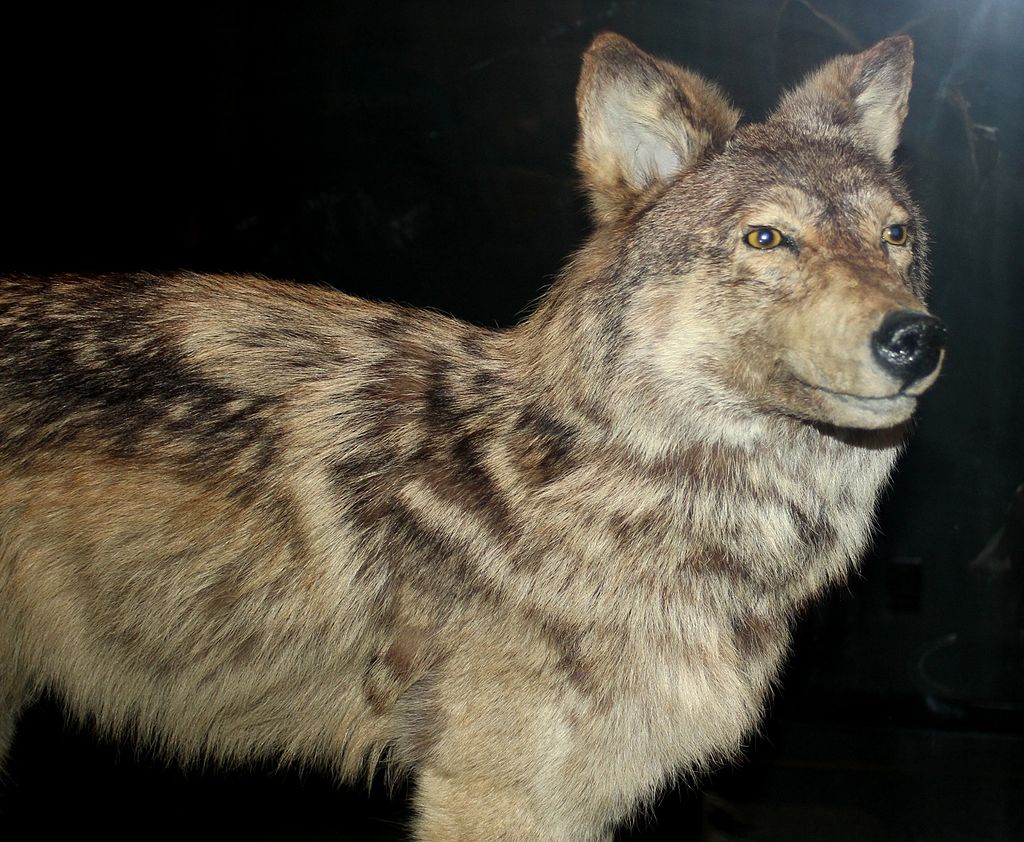
Also called the Honshu wolf. It lived on Honshu, Shikoku and Kyushu, but not on Hokkaido, which had its own larger wolf. The last known animal was killed at Washikaguchi in Nara Prefecture on 23 January 1905.
The scientific name is a compliment. Hodophilax is Greek for path guardian, after the Japanese folklore figure of the okuri-inu, the wolf that follows a traveller through the mountains and sees them safely home.
Rabies reached Japan in the eighteenth century, and the response was a policy of killing wolves outright, both to stop the disease and to protect the horse herds. Reverence turned to eradication inside a couple of generations.
4. The dire wolf (Aenocyon dirus)
The famous one, helped along by Game of Thrones. It weighed roughly 59 to 68 kg, comparable to the biggest gray wolves alive today, and it disappeared around 13,000 years ago.
It is also the entry on this list that is no longer a wolf in the strict sense. Ancient DNA work published in 2021 showed the dire wolf last shared an ancestor with gray wolves several million years ago, further back than the whole Canis radiation, and it was moved out of Canis into its own genus, Aenocyon. It looked like a wolf because it did the same job, not because it was closely related.
It shared its landscape with Smilodon, the sabre-toothed cat, and both turn up in enormous numbers in the La Brea tar pits in Los Angeles. Its range ran from southern Canada down through the Americas as far as South America.
5. The Florida black wolf (Canis rufus floridanus)
An all-black subspecies of red wolf from the southeastern United States, recorded as extinct in 1908. Trapping and the loss of its habitat finished it.
You will often see an Audubon plate of a black American wolf used to illustrate this animal. It is the image everyone reaches for, and it is worth knowing that the identification of the plate with this particular subspecies is a later convention rather than something Audubon stated.
6. The Texas wolf (Canis lupus monstrabilis)
Formally described in 1937 and declared extinct in 1942, which is an unusually short career for a subspecies. It ranged across Texas, into parts of Louisiana, and south into northern Mexico.
Its prey was American bison. When the bison were destroyed in the nineteenth century the wolves switched to cattle, and competing with the North American ranching industry of that era was not a survivable position.
7. The Newfoundland wolf (Canis lupus beothucus)
A medium-sized white wolf with a narrow head, endemic to the island of Newfoundland. The last known individual was killed in 1911.
Government bounties and general hunting did most of the damage, and a collapse in the caribou herds the wolves depended on removed whatever margin was left.
The pattern
Six of these seven went extinct within about a century of European settlement, or in Japan’s case rapid modernisation, reaching their range, and the seventh was a Pleistocene animal that also overlapped with people at the end. The dire wolf aside, none of them were killed by competition with other predators. They were killed by bounty schemes, pelt prices and the conversion of prey range into farmland.
That is a depressing list, but it is not the current direction of travel. Wolves are recovering across Europe and parts of North America, in landscapes far more crowded than the ones these seven lost.
For the wolves that are still here, see our complete guide to wolf species.
Wolf books and posters are in the We Love Wolves store.
Updated 8 October 2026: corrected the count of living wolf species and the extinction pattern.


Sad list. I’d never heard of the Newfoundland wolf before this.
There are museum specimens of a few of these, I think. Not much else left.
The Honshu wolf is the one that gets me. The last confirmed one was killed in 1905 and that was it.
had no idea there was a kenai peninsula wolf. gone so fast.