
7 Wild Creatures In The Same Family As Wolves
5 min read
Animals that howl, scream, cluck and whistle are all part of this motley crew of creatures in the same family as wolves.
Whatever the species, size or build, every wolf belongs to the family Canidae. Members are called canids, they are all furry, and they all carry cutting and slashing teeth, but that is roughly where the resemblance stops.
The family is varied enough that most of its members look nothing like a wolf at all. We already know the domestic dog is in there, so below we have picked seven wild ones instead.
How close are wolves and foxes?
Foxes are canids, but they sit on a separate branch of the family. Gray wolves belong to the genus Canis, in the tribe Canini with coyotes, jackals and dogs. Red foxes belong to Vulpes, in the tribe Vulpini. The two branches split millions of years ago, and their chromosomes no longer match: a gray wolf has 78, a red fox 34 plus a few small extra ones. Wolves and foxes cannot interbreed.
Size sets their lives apart. Wolves hunt deer, elk and moose as a family. A red fox weighs a few kilograms and lives on rodents, birds, insects, fruit and scraps, alone or as a pair raising cubs. Where the two meet at a carcass the fox gives way, and where wolves return, foxes stay on and feed on what the wolves leave.
7 wild creatures in the same family as wolves
7) Dingo (Canis lupus dingo)
Easy to mistake for a domestic dog, and there is nothing domestic about it.
The dingo is Australia’s largest living terrestrial predator, taking prey up to the size of a large red kangaroo, along with rabbits, rats and livestock. It growls, howls and barks, though barking is much rarer than in domestic dogs.
Its reputation has swung from the romantic to the demonic. Early European settlers wrote about devil dingoes, and the animal was hunted and poisoned on an enormous scale as a result. Dingoes are also unapologetic thieves, happy to lift human food or take an eagle’s kill.
The main threat to them now is not the rifle but the gene pool. Interbreeding with domestic dogs has long been seen as the main threat, though a 2023 genome-wide study found most wild dingoes it sampled were pure and that older tests had overstated their dog ancestry.
Fun fact: dingoes can rotate their wrists and have unusually flexible shoulder joints, which lets them climb trees and fences and turn door handles. Most dogs cannot do any of that.
6) Dhole (Cuon alpinus)
An Asian pack hunter, reddish and fox-faced, and a serious predator in its own forests.
Dholes hunt cooperatively in dense cover and regularly bring down prey many times their own size, including sambar deer. A pack can strip a carcass in minutes.
They are in trouble. The IUCN lists the dhole as Endangered, with fewer than 2,500 mature individuals thought to remain in the wild, squeezed by habitat loss, prey depletion, persecution over livestock, and disease passed on by domestic dogs.
Fun fact: the dhole is known as the whistling dog. It coordinates the pack with a whistle sometimes written as coo-coo, and its repertoire also includes screams, whines, growls and a chicken-like chattering. It does not howl or bark.
5) Golden jackal (Canis aureus)
Also called the Eurasian golden jackal, the common jackal and the Asiatic jackal.
It is widespread across parts of Europe, the Middle East and South Asia, and it is still expanding its range northwest through Europe. A famously flexible diet is a big part of why: fruit, insects, carrion, rodents, small ungulates, refuse, whatever the season offers.
The golden jackal is a close relative of the wolf and can produce fertile hybrids with both gray wolves and African wolves.
Fun fact: jackals chorus. One starts, and every jackal within earshot answers, which is how researchers count them.
4) Bush dog (Speothos venaticus)
Stocky, squat and badger-shaped, and one of the least dog-looking dogs alive.
Bush dogs are so rarely seen across their South American range that the species was first described from fossils and assumed extinct before anyone found a living one. Their closest relative is the maned wolf, which looks nothing like them either.
They hunt in groups, they hunt in water, and they have partially webbed feet for it. The nickname vinegar dog comes from the smell of their urine.
Fun fact: they are so good at hiding in undergrowth that camera traps regularly get the only evidence a population exists at all.
3) African wild dog (Lycaon pictus)
Mottled coat, huge round ears, and a scientific name that means painted wolf.
They live in tight-knit packs across sub-Saharan Africa and range over enormous territories. Their hunts are among the most successful of any large carnivore, well ahead of lions, achieved by running prey down over distance rather than ambushing it.
African wild dogs are listed as Endangered, with the pack structure itself part of the problem: lose a few adults to snares or disease and the whole pack’s ability to raise pups collapses.
Fun fact: the species has collected more names than almost any other carnivore, including African hunting dog, painted dog, painted hunting dog and painted wolf.
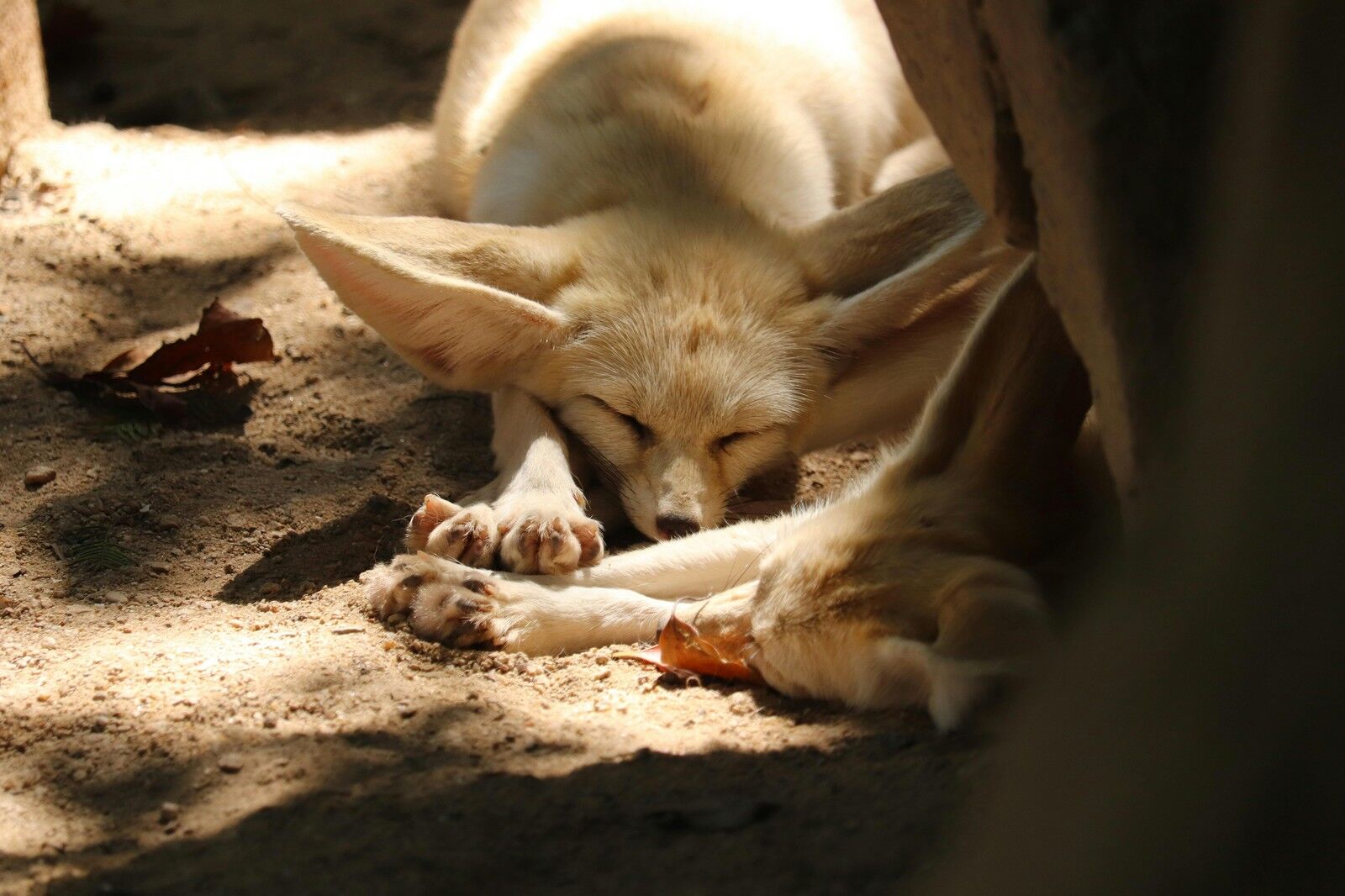
2) Fennec fox (Vulpes zerda)
The one you look at twice to check the ears are real.
It is the smallest fox in the world, and a single ear can be a third of its body length. Fennecs live in the Sahara and across northern Africa, spend the day underground away from the sun, and hunt at night.
Their size and their disposition have made them a target of the exotic pet trade, which is not good news for the wild population or for most of the animals sold.
Fun fact: those ears are radiators. They dump body heat into the air, which is why the smallest fox has the biggest ears.
1) Japanese raccoon dog (Nyctereutes viverrinus)
The strangest one on the list. The tanuki has the face and markings of a raccoon and none of the ancestry, because it sits squarely inside the same family as wolves.
Raccoon dogs are also the only canids known to hibernate, though how deeply depends entirely on where they live. Populations in the harshest parts of the range go properly dormant. Others barely slow down, holing up only during severe snow.
Fun fact: in Japanese folklore the tanuki is a shapeshifter, a master of disguise, and reliably a bit of an idiot about it. Jolly, mischievous, and easily caught out.
Bring wolves home
Love what you read? Browse our wolf merchandise store for gear inspired by these incredible animals:
- Shop wolf books
- Shop wolf clothing
Read more in our complete guide: Wolf Species: A Complete Guide.
Updated 8 October 2026: updated the dingo hybridisation section with the 2023 genome-wide findings; merged our post comparing wolves and foxes into this guide.



I’d like a source on the dingo head turning. They’re flexible, but that sounds like a lot.
same, i’ve seen it repeated but never with a source.
African wild dogs deserve more attention. Their hunting success rate is famously high.
dholes are the ones i knew least about. they whistle to each other, which is wonderful.