
Wolf Pack Mentality: How Wild Wolf Packs Actually Work
6 min read
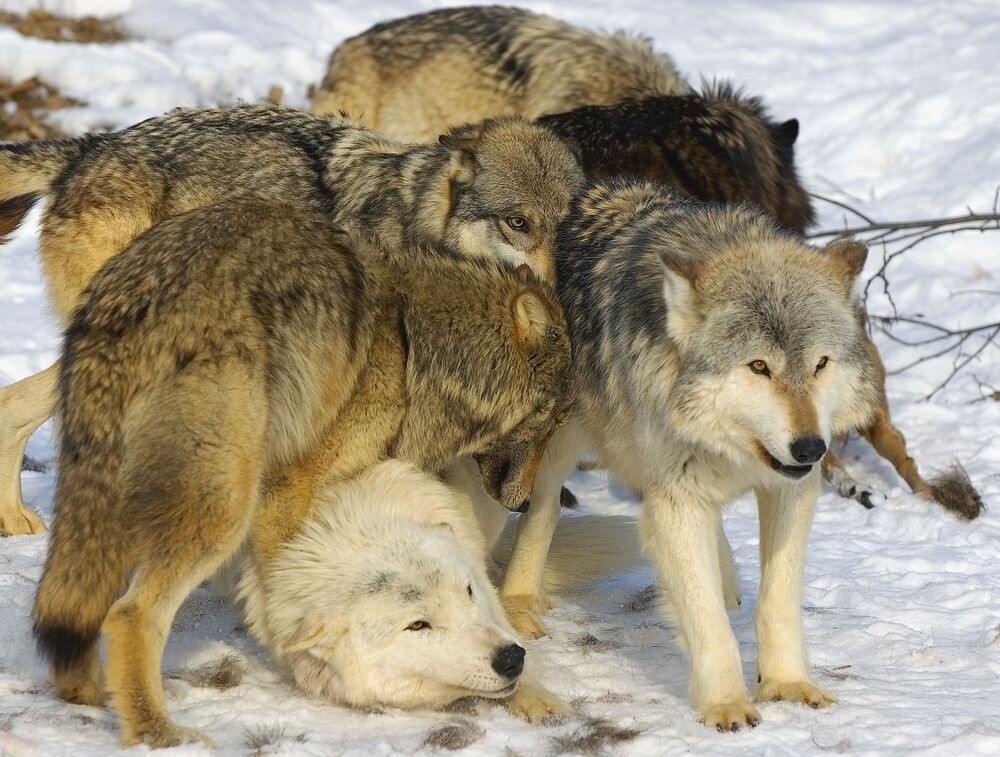
The alpha male ruling by aggression is a captive artefact, not a wild wolf pack. A wild pack is a family: a breeding pair and their offspring from the last one to three years. The parents lead because they are the parents. L. David Mech, whose 1970 book put the alpha vocabulary into general circulation, published a paper in 1999 arguing that the term should be dropped.
Where the alpha idea came from
Rudolph Schenkel studied captive wolves at Basel Zoo and published his findings in 1947. The animals he watched were unrelated adults confined together, and what he described was a dominance hierarchy. Mech’s 1970 book The Wolf made that framing the standard reference for two decades, and it is where most people first met the word alpha applied to wolves.
Mech then spent 13 summers, from 1986 to 1998, watching a wild pack on Ellesmere Island in the Canadian Arctic, and concluded that wild packs look nothing like the Basel groups. His 1999 paper in the Canadian Journal of Zoology, “Alpha status, dominance, and division of labor in wolf packs”, argued that alpha is simply the wrong word for a breeding parent. The term has been out of the wolf literature for a generation. It has not budged in popular culture.
Mech now uses breeding male, breeding female or simply parents, and has asked his publisher to stop reprinting the 1970 book because its account of pack structure is out of date.
What a wild pack actually is
Two breeding adults and their offspring from the last one to three years. The pair are the parents of everyone else, so their authority is parental rather than won. It resembles a human household with grown children still living at home more than it resembles a hierarchy.
Pack size tracks prey size. Where moose, bison or muskox are the main food, packs run larger, because putting one of those animals down takes coordination. Where deer, hare and rodents dominate, packs are smaller. Four to twelve is typical, and packs of over 30 have been recorded in Yellowstone at peak. The largest the park has recorded was the Druid Peak pack, with 37 wolves in 2001 (National Park Service).
Leadership is parental, not dominant
The breeding pair lead movements, pick denning sites and start hunts. Younger members follow because that is what young social mammals do, not because they are being held down. Serious aggression inside a pack is rare. When food is short the breeders eat first, being the primary hunters, and the surplus moves down through pups, yearlings and older offspring.
Body language carries most of the traffic and most of it is quiet. Tail position, ear position, eye contact and posture all signal. Lowered head, half-rolled belly, licked muzzle: submissive signals are far more common than aggressive ones and are the main social glue. Most of what popular accounts call alpha behaviour is closer to a parent telling a child to leave the biscuit tin alone.
None of this means wolves have no status at all. Older offspring assert themselves over younger ones and pups defer to adults, an order based on age that reads more like a household than a ranking. The captive dynamics Schenkel described are real too: put unrelated adult wolves in one enclosure and they do sort themselves into a dominance hierarchy. They tell you little about a wild family.
Hunting together
A pack hunt on large prey is closer to a slow stalking test than a charge. The pack approaches, pushes the herd to spread it, picks out a weak or distracted animal, and then pursues. Most attempts fail. Mech’s Isle Royale work, where he watched wolves detect 131 moose, ended with six kills, and that ratio is roughly what other studies find.
Once prey is down, lead wolves take the throat or nose while the rest work the flanks and rear. A moose carcass feeds a pack of eight for several days. The breeders usually eat first, and younger wolves stealing scraps from underneath them are not seriously punished for it.
Howling and scent
Howling works over long distances for locating packmates, advertising a territory, and regrouping after a separation. Each pack has a recognisable chorus signature and individual wolves have voices distinct enough to identify spectrographically. Lunar phase does not predict when wolves howl; time of day and what the pack is doing both do.
Scent marking is the second channel. Peters and Mech’s work on raised-leg urination found breeding wolves marking every few hundred metres along their trails, with the rate rising near territorial boundaries. Scratch marks, urine and scat all carry information about pack identity, breeding status and how recently someone came through. Whole-pack greetings, with collective howling and muzzle licking, happen several times a day in a healthy pack.
Dispersal
Young wolves usually leave between one and four years old to find a territory and a mate. Dispersal distances run from a few kilometres to well over a thousand: the Slovenian wolf known as Slavc walked roughly 2,000 km into northeastern Italy over 2011 and 2012, tracked the whole way by GPS collar, and paired with a female there. Most dispersals are far shorter, often ending in adjacent vacant ground or alongside a recently widowed breeder.
Dispersal is dangerous and a large share of dispersers die before settling. Those that make it pair with another disperser, claim ground, and start a family pack of their own. That is the normal route to a new pack; splitting an existing one in place is the exception.
Where the myth still does damage
Dog training methods built on dominance corrections, alpha rolls and forced submission are still promoted online with no scientific basis behind them. The American Veterinary Society of Animal Behavior’s position statement on dominance theory says plainly that this approach is both ineffective and damaging to welfare.
It also distorts wolf politics. A lone disperser gets described in lethal control arguments as a rogue or a reject, when it is a young animal doing the ordinary thing wolves do at that age. Whether the public understands that shapes whether protections for dispersing animals survive a vote.
What happens when a breeder dies
The survivor usually pairs with a new disperser within a year. If both breeders die the pack often dissolves, with older offspring dispersing and the younger ones either following or failing. Yellowstone has the best long-run data on this, and the Druid Peak pack is the case everyone cites: from a peak in the early 2000s it came apart over the following decade as deaths ran through its breeding line, ending in 2010.
Continuity over decades is rare but real. Mollie’s pack in Yellowstone traces back to the 1995 releases and has held together through many generations, which takes good prey density, low human-caused mortality and a stable breeding line all at once.
Related reading on welovewolves
- Gray wolf species profile
- Do wolves howl at the moon?
- Do lone wolves really exist?
- The end of the Yellowstone Druid pack
- The history of wolves and dogs
Frequently asked questions
Is there really an alpha wolf?
Not in the sense the word usually carries. The breeding pair in a wild pack are the parents of everyone else and lead on that basis. Mech, who put the term into wide use in 1970, spent the following decades arguing against it and published that argument in 1999.
What is a typical pack size?
Four to twelve in most populations, larger where the prey is big, smaller where it is not. Yellowstone’s largest recorded pack was Druid Peak, with 37 wolves in 2001.
Do wolves have omegas?
Not in a healthy wild pack. The omega comes from the same captive setup that produced the alpha. In a family group of close relatives there is no scapegoat at the bottom.
When do young wolves leave?
Between one and four years old, usually. Some go a few kilometres, a few go over a thousand. Many do not survive the attempt.
Can two unrelated wolves form a pack?
That is the normal way it happens. Two dispersers from different natal packs meet, claim ground, and breed. The captive arrangement of unrelated adults penned together is the artificial case, not the natural one.
Precise figures for disperser survival and for what share of new packs come from dispersal get quoted a lot and we have not been able to trace them to a single study. If you know the paper, leave a comment and we will cite it properly.
Updated 8 October 2026: added the National Park Service record for Yellowstone’s largest pack; merged our post on the alpha wolf myth into this guide.
Updated 14 November 2026: corrected the study behind Mech’s 1999 paper: 13 summers on Ellesmere Island, not 25 years across four regions.



Awesome story and facts. Love the wolves
Love to read these stories they are such amazing animals love the woles
very big packs happen but they seem rare. most of the ones i’ve read about are a family of maybe five to ten.
The alpha idea came from captive wolves that weren’t related to each other. Wild packs are mostly families.
Agreed. Old habits in wolf writing die hard.
a wolf on its own has a much harder time. loyalty helps them survive, doesn’t make it any less real.