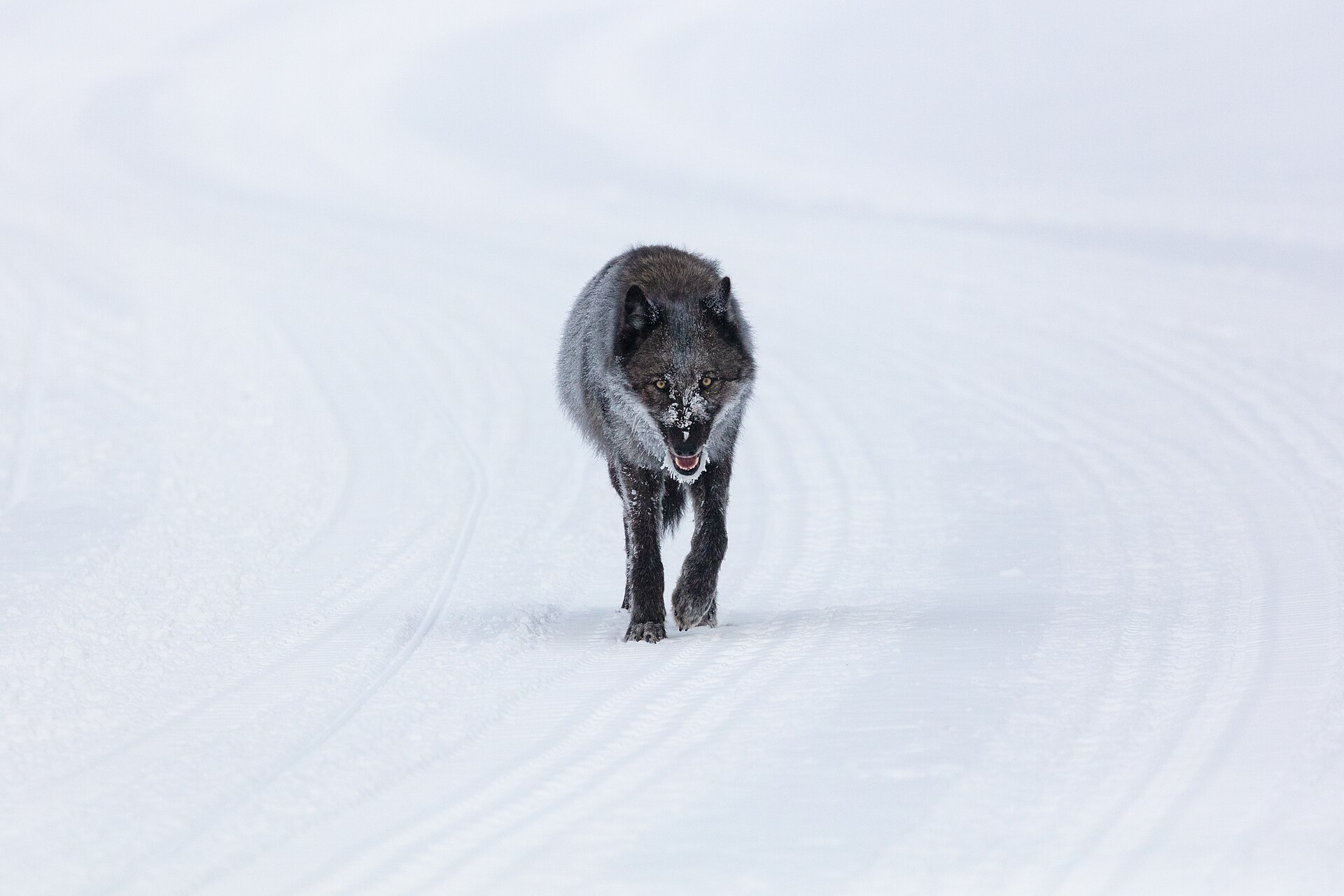
How Wolves Move in Snow: Feet, Footload and Snowfall
4 min read
A wolf crossing fresh snow leaves a print that looks too big for the animal. The foot is wide, the toes spread, and the whole thing sits on top of the drift instead of punching through it. That is not an accident of looks. Feet are one of the main tools a wolf uses to get through a northern winter, and the research below sets out what they do and what they do not do.
This post covers the feet, a measure called footload, what a wolf pack actually does when snow starts to fall, and where the science runs out.
A paw that spreads
The International Wolf Center describes the effect with a photo of a wolf named Denali. When a wolf puts weight on its paw, the toes fan out. The Center says this gives more surface area on each step, which helps stability and reduces how far the animal sinks into snow. The toes also have partial interdigital webbing, a stretch of skin between them that adds to the spread.
The idea is the same as a snowshoe. Weight spread over a bigger area presses less on each square centimetre of snow. A paw that fans out under load and narrows again when lifted gives a wolf a wide platform without a permanently wide foot.
If you want to see the print itself, our guide to telling wolf tracks from dog tracks covers what to look for on the ground.
Built to keep moving
Feet only work if the legs above them are efficient. The International Wolf Center notes that a wolf’s elbows turn inward, so its lean body is balanced over large feet. Combined with long legs and what the Center calls a ground-eating stride, the wolf can travel for hours without wasting energy.
That matters because a wolf pack is a travelling animal. Hunting is mostly a matter of covering ground until you find prey that is vulnerable, and a body that moves cheaply is the base of everything else. The same page puts the upper end at 50 miles or more in a day. That is a ceiling, not a typical day, and the measured winter figures later in this post are much lower.
The long legs pay off in another way. Researchers in Alberta, writing in a 2018 PLOS ONE study, point out that wolves are lighter on their feet and more agile in deep snow than many of the hoofed animals they hunt. The same paper notes that snow with an unsupportive crust sharply raises the cost of movement and makes it harder for prey to escape. Several studies it cites report better hunting success for wolves in deep snow.
What footload tells us
Biologists compare animals in snow with a number called footload: body mass divided by the surface area of the feet. A low footload means less weight on each patch of snow. In theory, animals living where snow is deep and soft should end up with large feet for their weight.
A team led by Murray and Larivière tested this on wild canids and published it in the Journal of Zoology in 2002. They collected 472 coyotes, 199 red foxes, 52 arctic foxes, 17 grey foxes and 14 wolves and measured mass, foot area and footload.
The results were more cautious than the snowshoe story. Red foxes living north of 48 degrees latitude, roughly where snow starts to limit movement, averaged 12 percent larger feet than southern ones. Northern coyotes had feet 25 percent larger and were 26 percent heavier. But coyote body shape did not track any of the snow measures the team used, and the authors concluded that snow may have contributed to foot size in some canids, notably the arctic fox and red fox, but the pressure was “relatively weak and inconsistent across species.”
Wolves were the smallest sample in that paper, only 14 animals, so it would be unfair to read a wolf conclusion from it. The honest summary is that the snowshoe effect is real for some canids and unproven for wolves in particular.
What a pack does when snow falls
The best direct evidence on wolves comes from northeastern Alberta, near Fort McMurray. In January to March of 2013 and 2014, researchers Droghini and Boutin fitted 17 wolves from nine packs and one lone animal with GPS collars that logged a position every 10 or 30 minutes, and used remote cameras to date snowfall events. Their findings are in The calm during the storm.
Wolves were less likely to travel on the date of a snowfall than on any day before or after it. They also moved slower during snowfall, but only compared with their speed 24 hours earlier. The effect was strongest at night, which is when their movements looked most like hunting. Activity returned to normal within 24 hours.
Some of the figures in the paper:
- Mean travel speed was 26.3 metres a minute at night and 20.3 by day.
- On snowfall dates the wolves covered an average of 10.06 km a day.
- On other days the averages ranged from 11.30 to 13.14 km a day.
Here is the surprising part. Snow depth did not help predict how wolves moved, even though the cameras recorded depths above the 40 to 50 cm at which wolves are expected to be impeded. So deep snow was not the brake. The falling snow itself was.
The authors suggest the likely reason is hunting, not effort. Falling snow may make it harder for wolves to smell and detect prey, and changes in prey behaviour could lower encounter rates, so a wolf may gain little from travelling. Wolves seem to wait the storm out and resume once it passes. The authors present this as a proposal and encourage more research.
Putting it together
A wolf’s feet and legs give it a real edge on snow. The paw spreads, the toes carry webbing, and the long, efficient build lets it keep travelling when hoofed prey struggles. What the science does not show is that wolves are unaffected by winter. A pack in Alberta slowed down and moved less on days when snow fell, and it moved again once the weather settled.
For more on how a winter pack finds food, read our post on how wolves hunt, and on the senses involved, how wolves see at night.
Have you followed wolf tracks across snow, or have a record of winter movement to share? Add what you know in the comments.
Sources
- International Wolf Center: Denali, feet made for snow walking
- International Wolf Center: wolf FAQs
- Murray and Larivière (2002), Journal of Zoology, Cambridge University Press
- Droghini and Boutin (2018), PLOS ONE
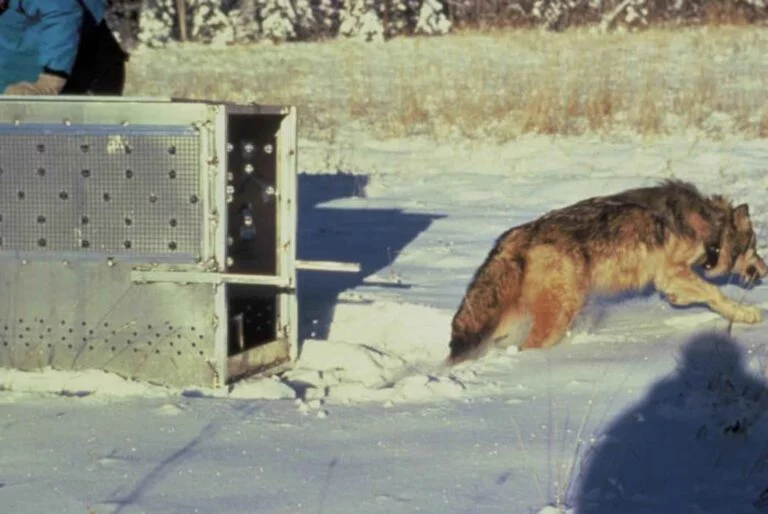
Photo: Yellowstone National Park, Public domain, via commons.wikimedia.org.