How Do Wolves Hunt? Cooperative Strategy Explained
5 min read
Wolves hunt cooperatively in packs, using endurance and coordination rather than ambush. A hunt may run for hours over many kilometres. Most attempts fail. Wolves select for the weakest individual in a herd, test for vulnerability, and only commit when the odds are right. A wolf hunt is a long-distance test. The pack tracks prey, tests for vulnerability by short rushes, and only commits to a kill on individuals that show weakness. Most hunts fail (10 to 20 percent success rate). When the hunt succeeds the pack brings the prey down by biting and holding the hindquarters, flanks and sometimes the nose, often with multiple wolves attacking at once.
Part of our guide: Wolf Behavior.
Phase 1: Tracking
A wolf pack travels 15 to 50 km per night during active hunting. They use scent (the dominant sense, never measured but estimated at thousands of times better than a human’s), sight, and sound to locate prey. They follow scent trails, listen for breathing or rustling, and watch for movement at distance.
Travel is in a deliberate single-file line, often with the breeding male leading. The pack moves at a steady 6 to 8 km/h trot, conserving energy. Wolves can travel for many hours without rest. The tracking phase often takes most of the hunt’s duration.
Phase 2: Testing
Once prey is found the pack moves into testing mode. This is where the hunt’s outcome is decided. Wolves approach the herd, sometimes initiating short rushes, watching how individual animals respond. They look for limps, hesitation, ill health, age, isolation from the herd, or any sign of vulnerability.
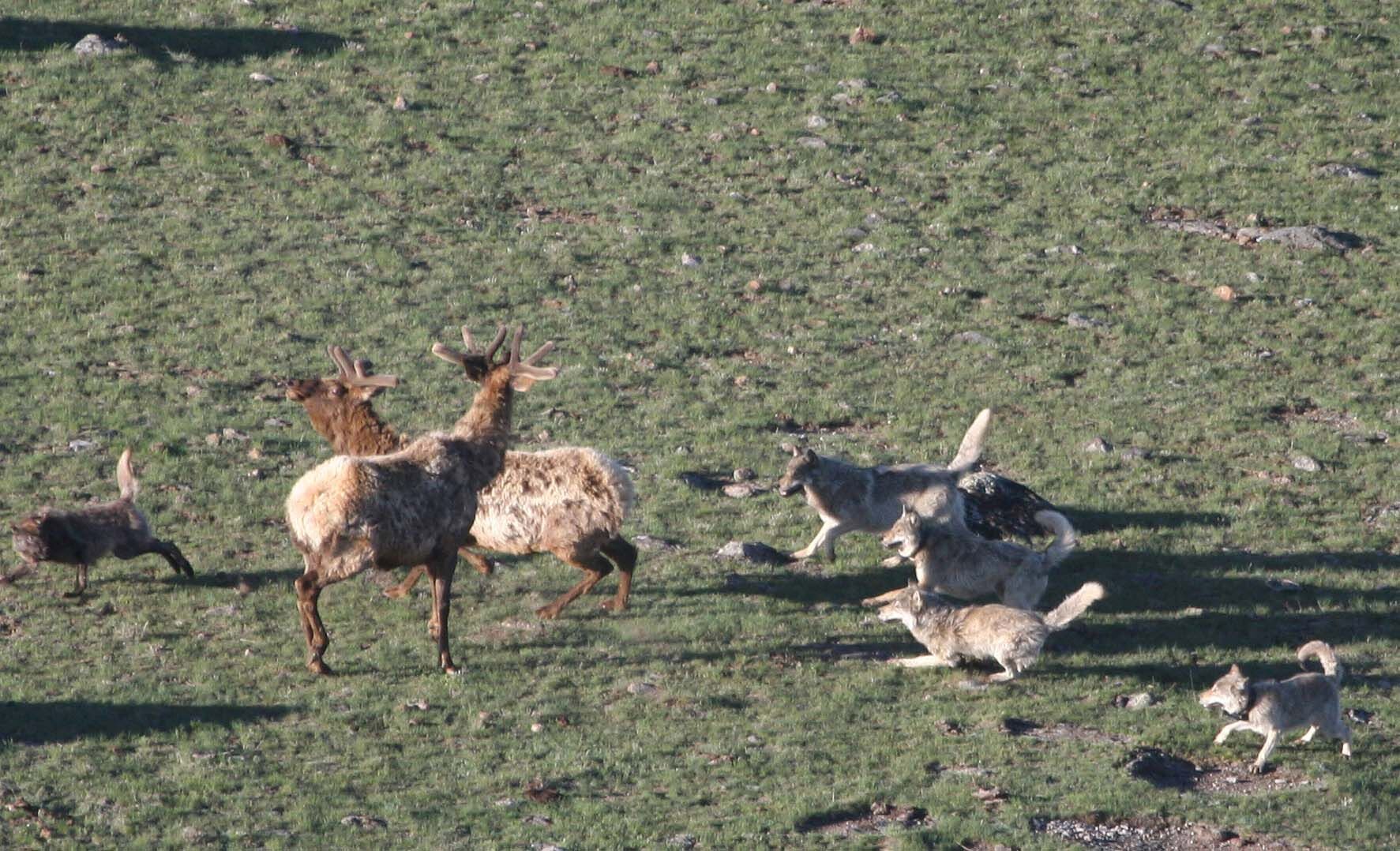
Healthy adult prey usually scatters or holds its ground. A bull moose or full-grown elk facing a wolf pack will often turn to face them and stand. Most wolf approaches end here, with the pack moving on after a few seconds of testing. Hunting is mostly walking and testing; only a small fraction ends in committed pursuit.
Kill records show what the testing is for. In Yellowstone, wolf-killed elk are mostly calves and old cows, and prime-age adults make up a much smaller share of kills than they do of the herd. Terrain counts too: elk under pressure head for steep, broken or rocky ground, where wolves lose their advantage.
Phase 3: Pursuit
If a vulnerable individual is identified the pack switches into pursuit. The chase distance varies: sometimes 100 m, sometimes several kilometres. Wolves use coordinated angles to cut off escape, with different pack members taking different positions. Multi-wolf coordination is the wolf’s main hunting advantage over ambush predators.
Snow and rough terrain favour wolves over long-legged prey like elk and moose. Hard crusts that hold wolves but break under heavier hooves are ideal, because a wolf’s broad paws spread its weight like snowshoes. In open terrain or shallow snow, healthy prey usually outruns the pack.
Phase 4: Kill
Once the pack catches the target it grabs and holds on. Wolves bite the hindquarters, flanks and sometimes the nose, and drag the animal down. Multiple wolves attack from different angles. Death comes from blood loss and shock, and it is often slow, slower still for moose or bison.
Bison hunts and moose hunts can take much longer. A single moose can hold off a wolf pack for hours and even kill or wound multiple wolves. Wolves only commit to such hunts when prey shows signs of weakness or when the pack is large enough to overwhelm.
How many wolves a hunt needs
More wolves do not mean proportionally more kills. Watching known Yellowstone wolves hunt elk, MacNulty and colleagues (2012) found that success rose with group size up to about four wolves and then levelled off, partly because some wolves in bigger groups held back from the dangerous work of grabbing and holding the prey. For bison, a far more dangerous animal, a later study by the same team (2014) found success kept rising until about 9 to 13 wolves.
So large packs are not explained by hunting alone. Holding territory against neighbouring packs, raising pups and defending a carcass from scavengers and other wolves all favour numbers.
Phase 5: Feeding and recovery
Once the prey is dead the pack feeds together, with the breeding pair usually eating first. A wolf can eat 15 to 20 percent of its body weight in one sitting, up to about 10 kg for a 50 kg wolf. The pack will return to the carcass over days, often defending it from scavengers (ravens, bears, coyotes).
Wolves recover quickly from successful hunts. Within 24 hours they are often back to travelling. The energetic cost of hunting (long travel, occasional injuries) is one of the main reasons wolves do not hunt every day; gorging and then fasting is the normal pattern of the wolf diet.
Pups are fed by every adult in the pack. A pup nuzzles the corner of an adult’s mouth and the adult brings up meat; yearlings do this as readily as the parents. What the pack cannot finish gets cached: wolves bury meat or bone in shallow holes, cover it with soil or snow, and return to it over the following days. Caches matter most to the animals least able to compete at a carcass, such as pups and a denning mother.
Related reading
For wolf fans browsing for something to take home, see the We Love Wolves store.
Frequently asked questions
How do wolves hunt?
Cooperatively, over long distances, using endurance rather than ambush. A pack tracks prey for kilometres, tests individuals for weakness, and only commits to a kill on vulnerable targets. Most hunts (80 to 90 percent) end before the kill phase.
How long does a wolf hunt take?
Variable. Tracking and testing can run several hours. A successful chase phase may last 5 minutes to several hours. Long bison and moose hunts can last most of a day. Failed tests end quickly, often within seconds.
Do wolves kill from the throat?
Rarely. Wolves have no single killing bite. They grab the hindquarters, flanks and sometimes the nose, multiple wolves attack from different angles, and the prey dies from blood loss and shock.
What is the wolf hunt success rate?
10 to 20 percent of attempts succeed on healthy adult prey. Calf and weakened-individual hunts succeed more often. Most wolf encounters with prey end without a successful chase phase.
How many wolves are in a hunting party?
Typically 2 to 6 active hunters per attempt, drawn from the pack’s adults and older yearlings. Pups stay at rendezvous sites until they are around 4 to 6 months old. Mating-season hunts may involve fewer adults; pup-rearing season hunts may use older yearlings as helpers.
Do wolves chase prey to exhaustion?
Sometimes, but not always. Most hunts end before exhaustion either because the prey escapes or because it shows weakness early enough for a quick kill. Exhausting moose chases in deep snow are the iconic case but are not the typical pattern.
Can wolves take down a moose?
Yes, but only in specific conditions: deep snow, multiple wolves, and prey showing signs of weakness. A healthy adult bull moose facing the pack head-on usually wins. Most moose kills are calves or sick adults.
Do wolves hunt at night?
Crepuscular and nocturnal mostly. Wolves are most active at dusk, through the night, and into dawn. Daytime hunting happens in winter and in undisturbed areas like Yellowstone.
Last updated 8 October 2026.
Updated 8 October 2026: corrected how wolves kill large prey, the sense of smell and feeding figures, and removed unsourced kill time and success rate figures; merged our posts on pack size, prey selection, cooperation and the feeding order into this guide.