
10 Wolf Facts You Probably Did Not Know
4 min read
Ten things about wolves that hold up when you go looking for the source. Where a popular claim did not hold up, we have said so rather than quietly repeating it. To test yourself afterwards, try our wolf trivia quiz.
1. The man who popularised alpha wolves spent decades arguing against it
L. David Mech did not invent the alpha idea, but his 1970 book The Wolf put it into every nature documentary for a generation. He then spent the following decades watching wild packs and concluding the framing was wrong. He now argues for breeding male, breeding female or simply parent, on the grounds that most wolves leading packs got there by having pups rather than by winning fights.
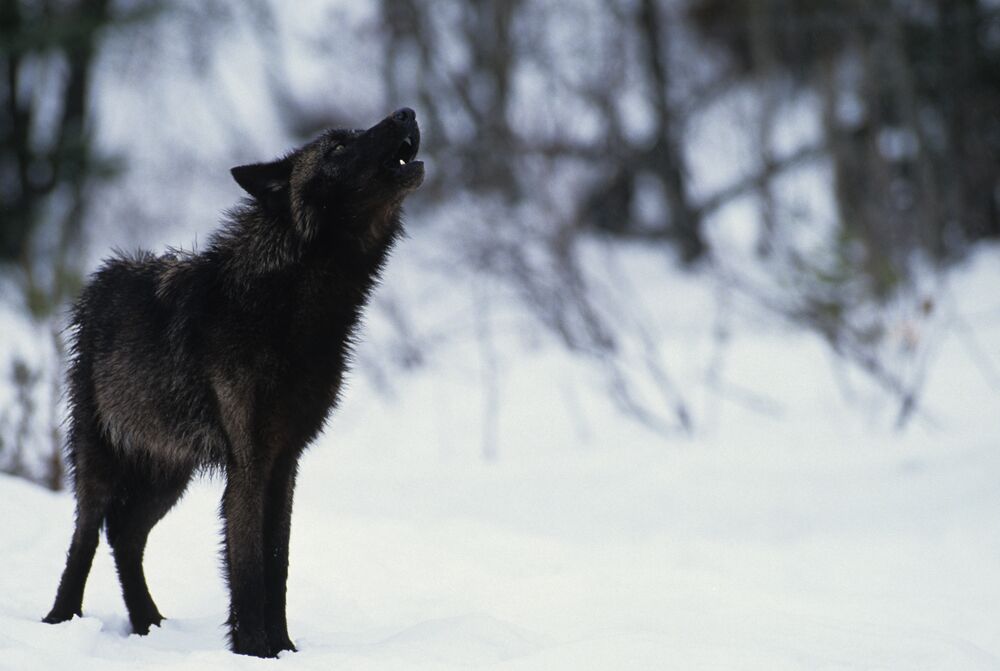
2. Wolves do not howl at the moon
Lunar phase has no effect on how often wolves call. What the moon provides is a bright backdrop for a silhouette, and a raised muzzle is simply how you project a howl. In good conditions that howl carries across an area of up to 130 square km, which is the actual reason for the posture.
3. Smell is the sense that runs the animal
A wolf’s world is olfactory in a way ours is difficult to imagine. Scent tells it who crossed this trail, how long ago, whether they were a stranger, and whether they were healthy. Wolves mark far more heavily in unfamiliar ground and along boundaries where another pack has been, which turns a territory edge into a written record. The multiplier figures you see quoted for wolf smell against human smell vary wildly between sources, so treat any precise number with suspicion.
4. A typical pack is smaller than you think
Average pack size is eight in North America and 5.5 in Europe. The giant packs that get written about are genuine outliers: packs of more than 30 have been recorded, but only where prey is both large and abundant. If you see a photograph of a dozen wolves together, you are looking at an unusually good year.
5. Most hunts fail
Wolf hunting success on large hoofed prey is low. The pack tests many more animals than it kills, and the selection process, older, weaker, isolated, injured, is doing most of the work. Wolves are not fast compared with the cats. They win on stamina and on picking the right animal, which is also why they so often lose.
6. Yellowstone’s elk count halved after the wolves came back
Between the winters of 1995 and 2004 the northern range elk count fell from roughly 16,800 to 8,300 while the wolf population rose from 21 to 106. Aspen and willow recovered along stream corridors, beaver followed, and wetlands rebuilt. How much of that was wolves and how much was drought and human elk hunting is still argued over in the literature. The honest version is that wolves were necessary but not sufficient.
7. Wolves were deliberately erased from the lower 48
Bounties, strychnine baited carcasses and federal predator control removed wolves from the contiguous United States over roughly two centuries, leaving a remnant in northern Minnesota by the middle of the twentieth century. The 1973 Endangered Species Act listing began the reversal and the Yellowstone releases of 1995 and 1996 were its most public moment. This was not habitat loss. It was policy.
8. Wild wolves rarely reach eight
Six to eight years is a normal wild lifespan, against fifteen or sixteen in captivity. Humans account for most deaths, with other predators and lean winters taking the rest. Some articles claim a Yellowstone female called 832F lived to thirteen. She did not: 832F, the famous 06 Female, was shot in December 2012 at six years and eight months old.
9. The Indian wolf split off long before the others
Whole genome work published in 2021 found the Indian wolf to be one of the oldest surviving branches of the species, possibly the oldest. The IUCN’s 2025 assessment, the first for the Indian wolf on its own, lists it as Vulnerable with about 3,093 mature animals in India and Pakistan. It is protected under Schedule I of India’s Wildlife Protection Act, and it lives in small packs on dry grassland rather than in forest.
10. Dispersing wolves cover extraordinary distances
Young wolves leave home, sometimes at one year old, sometimes at four, and walk until they find an empty territory and a partner. That habit is the single reason wolves recolonise ground so quickly once the shooting stops: France, Germany and Denmark all got their wolves back on foot rather than by reintroduction. Specific record breaking journeys get quoted constantly, usually without a citation attached, so we are not going to name one. If you know of a properly documented long distance dispersal with a source, leave a comment and we will add it.
Frequently asked questions
How smart is a wolf compared to a dog?
They are good at different things. Captive comparison work at the Wolf Science Center in Austria has repeatedly found wolves better at independent problem solving and dogs better at reading human cues. Domestication shifted dogs toward cooperating with us rather than working things out alone.
How fast can a wolf run?
Around 60 km/h in a short burst and 25 to 30 km/h at a travelling pace it can hold for hours. The stamina is the weapon, not the sprint.
Are wolves dangerous to humans?
Very rarely. The Norwegian Institute for Nature Research recorded 489 wolf attacks on people worldwide between 2002 and 2020, of which 26 were fatal and 14 of those deaths involved rabies. Most happened in Turkey, Iran and India.
How long are wolves pregnant for?
About 63 days, with a reported range of 62 to 75. Mating is in late winter and pups arrive in spring, four to six in a typical litter.
How big is a wolf’s territory?
Anywhere from about 100 to 2,500 square km. Territories shrink where prey is dense and expand across the Arctic and the central Asian steppe where it is not.
How many wolves are there worldwide?
Somewhere in the range of 200,000 to 250,000 wild gray wolves. Russia and Canada hold the most, and Russia has the shakiest count.
Updated 8 October 2026: corrected the wolf attack figures to the 2021 NINA report, the record pack size, and the date and status details for the Indian wolf; also corrected which countries hold the most wolves.


the ravens and wolves thing is my favourite. ravens turn up at almost every kill.
Some of the very big weight records get repeated without much of a source. I’d treat them with care.
Agreed. The one cited most is a 175 pound wolf killed in Alaska in 1939, and even that was unusual.
Is the plague link to werewolf stories well supported? I’d like to read more on that.