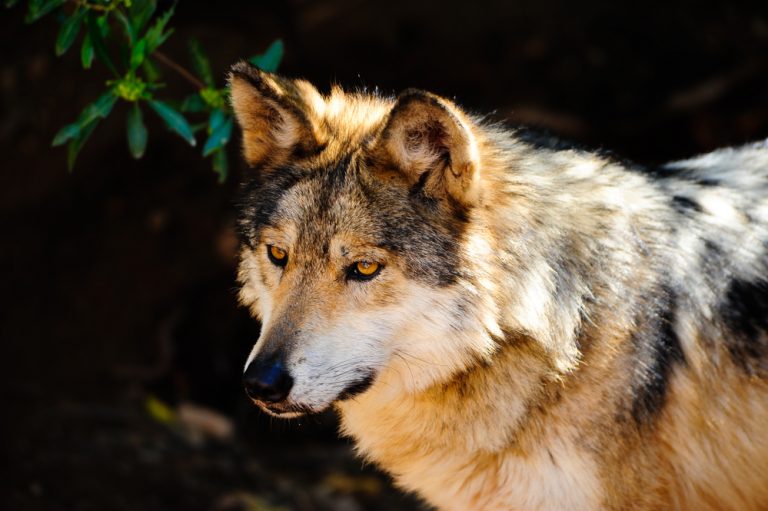
Wolves and Ravens: A Winter Partnership in Yellowstone
4 min read
A wolf kill in winter draws a crowd. Before long, black shapes drop out of the sky onto the snow, and the wolves that made the kill have to share. The birds are common ravens, and in Yellowstone National Park they are some of the most reliable company a wolf pack has.
Ravens are big for a songbird. According to Wikipedia’s raven entry, an adult measures 54 to 71 cm (21 to 28 in) with a wingspan of 116 to 153 cm (46 to 60 in), which makes it one of the heaviest passerines. The same entry describes a bird that stores food, remembers where other ravens hide theirs and steals it. That memory turns out to matter a great deal for wolf kills.
Why ravens want to be near wolves
The simplest reason is food. The National Park Service says on its Yellowstone raven page that ravens are attracted to wolf kills and may follow wolves while they hunt elk. It also points to a practical limit: ravens cannot rip open thick skin on their own. A wolf pack can. Once the wolves have opened a carcass, the birds can reach meat that would otherwise stay sealed away.
For a bird that will eat almost anything, a large carcass opened by someone else is a very good find. Wolves leave scraps behind, so the ravens get a regular share.
If you want the wolf side of the story first, our post on how wolves hunt explains how a pack brings down large prey in the first place.
Do ravens lead wolves to prey?
This is the claim people repeat most. The Wikipedia entry says ravens associate with wolves as kleptoparasites, meaning they follow the wolves to scavenge kills in winter. It also reports that ravens have been observed leading hunting wolf packs to potential prey that only the birds can see from the air, and calling wolves to the site of dead animals.
Those are observations reported by others, and they make a good story. They are also hard to measure, which is why a newer study is worth reading closely.
What satellite tags found in Yellowstone
In March 2026, a team led by Matthias-Claudio Loretto published a paper in Science that tested the idea directly. They tracked 69 ravens, 20 wolves and 11 cougars in Yellowstone with satellite tags. The long-standing hypothesis was that ravens find carrion by following big predators to their kills.
The tags did not show that. Following predators over large distances rarely occurred. Instead, the ravens routinely revisited places where wolf kills were common, and some returned from up to 155 kilometres away to look for carrion.
The authors read this as memory. Ravens appear to remember potential sources of carrion shaped by their earlier encounters with wolves or their kills, in much the same way they navigate to permanent human food sources. Their conclusion is that spatial memory and navigation play a considerably greater role in scavenging than people had assumed.
That does not erase the older accounts of ravens near hunting wolves. It does mean a raven turning up at a kill site may be arriving from a long way off on purpose, rather than trailing the pack step by step.
How wolves changed the raven population
A separate team looked at numbers. Walker and colleagues counted ravens across Yellowstone’s Northern Range every March from 2009 to 2017, both in human-use areas and in wolf habitat. Wolves had been reintroduced to the park in 1995 to 1997, so the researchers could also model what raven numbers likely looked like before and after wolves returned.
Winter weather mattered. In relatively severe winters with deep snowpack, raven numbers rose around human-use areas and fell in wolf habitat. When wolves were able to acquire more carrion, ravens increased in wolf habitat and decreased around human food sources.
The study also looked at the time before wolves returned. Raven populations then were likely more variable and depended heavily on winter-killed ungulates and carcasses left by hunters. The authors concluded that wolf recovery helped stabilise raven populations by providing a regular food supply regardless of winter severity.
The park service gives a snapshot of the result. Recent surveys indicate 200 to 300 ravens on the Northern Range, and 53% of them are in wolf habitat, away from human areas. Before the reintroduction, nearly 74% of ravens likely used human areas, per the NPS raven page.
What this says about wolves and their ecosystem
Ravens are only one of many animals that live off what wolves leave. Kills feed birds, mammals and insects long after the pack has moved on. Our overview of why wolves matter to the ecosystem covers the wider picture, and the raven data shows one small piece of it with real numbers attached.
It also shows how far the effects of a predator reach. Bringing wolves back changed where a bird of another species spends its winter, and how steady its food supply is when snow is deep.
A note on feeding ravens
Ravens in Yellowstone are bold around people. The NPS notes they are frequently seen near parking lots searching for food, and some have learned to unzip and unsnap packs. Its advice is plain: do not feed them. Food handed over draws a wild bird toward people and away from wolf kills.
What is still unknown
The satellite study covers Yellowstone, and the population counts cover the Northern Range. How ravens behave around wolves in other regions, such as the Great Lakes or Scandinavia, is not covered by the sources used here. The reports of ravens guiding wolves also remain observations rather than measured results.
If you have watched ravens at a wolf kill, in Yellowstone or anywhere else, tell us what you saw in the comments.
Sources
- Loretto et al., Ravens anticipate wolf kill sites across broad scales, Science, 2026 (PubMed)
- Walker et al., Population responses of common ravens to reintroduced gray wolves, Ecology and Evolution, 2018 (PubMed)
- National Park Service, Raven, Yellowstone National Park
- Wikipedia, Common raven
Photo: Charles J. Sharp, CC BY-SA 4.0, via commons.wikimedia.org.