
Arctic Wolf: Profile, Facts, Range and Climate Threats
6 min read
The arctic wolf (Canis lupus arctos) lives further north, year round, than any other wolf: the Queen Elizabeth Islands of Nunavut and the northern coast of Greenland. Adults are 1.0 to 1.5 m long, white in every month of the year, and live in family groups of two to ten. Because almost nobody has ever hunted them, they show very little fear of people, which has made them one of the most closely observed wild wolf populations on Earth.
Key facts
- Also called: Melville Island wolf, polar wolf, white wolf
- Scientific name: Canis lupus arctos
- Shoulder height: 63 to 79 cm
- Body length: 1.0 to 1.5 m
- Weight: males around 45 kg, females around 36 kg
- Diet: muskox, arctic hare, Peary caribou, lemmings, birds
- Habitat: high Arctic tundra and polar desert on permafrost
- Pack size: 2 to 10
- IUCN status: Least Concern, assessed as part of Canis lupus
The white coat, all year
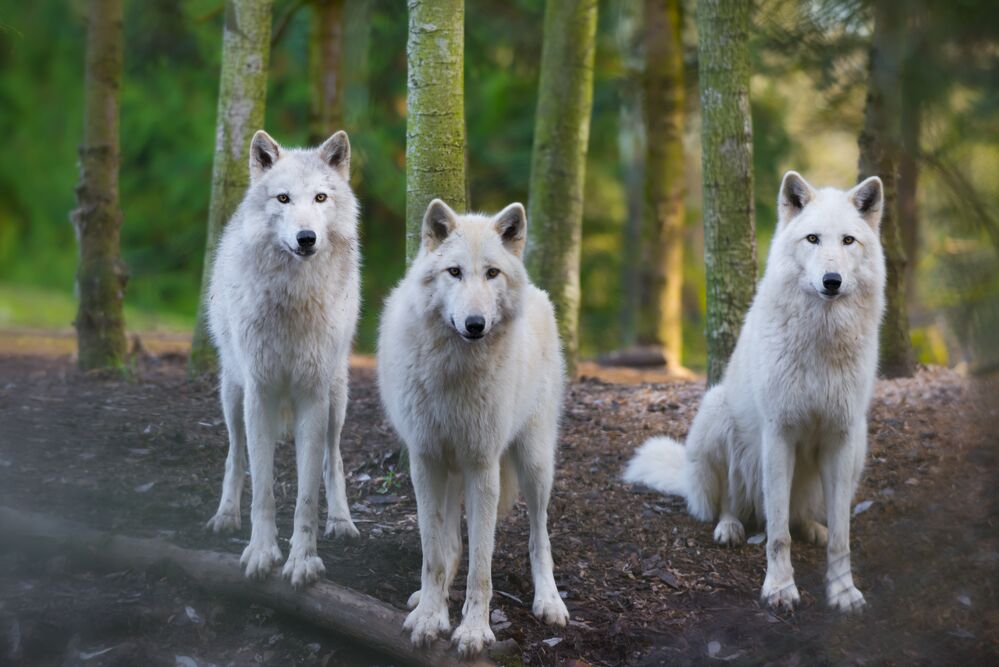
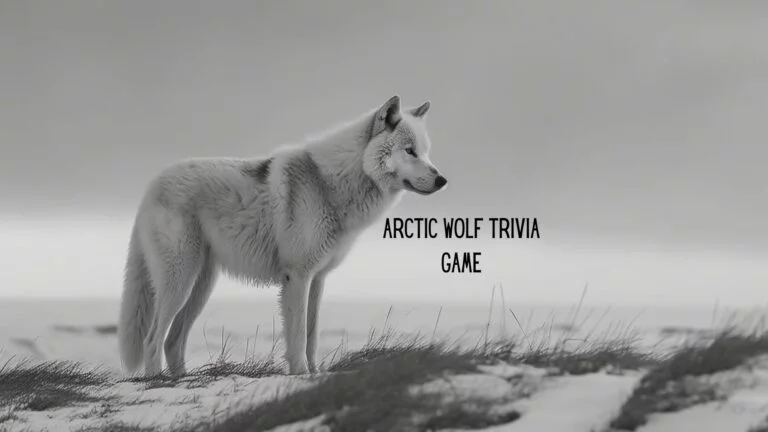
Arctic wolves stay pure white or palest cream through all twelve months, unlike arctic foxes and most arctic hares, which go brown in summer. The double coat is denser and longer than any other gray wolf’s, with a coarse outer layer that sheds driven snow over a woolly underlayer.
The proportions are all about heat. Muzzle shorter and broader than a temperate wolf’s, ears smaller, paws unusually wide with thick fur between the toes that works as a snowshoe and grips ice. Eyes are usually pale amber or yellow.
The short muzzle, small ears and short legs fit Allen’s rule: in colder climates, mammals tend to have shorter extremities, which lose less heat. The feet use countercurrent heat exchange. Warm blood flowing down to the paw passes close to cold blood returning from it, so heat goes back into the body and the pads stay just above freezing.
Where they live
The range is the Queen Elizabeth Islands of Nunavut, Ellesmere Island, and the northern coast of Greenland. This is about as hard as terrestrial mammal habitat gets: winter averages near minus 30 Celsius, total darkness from late October to mid February, and no soil above the permafrost.
Nobody knows how many there are. The islands are inaccessible, the wolves are at very low density across an enormous area, and no systematic count exists. Estimates circulate but none of them rest on a survey we can point at.
Some groups stay in the high Arctic year round. Others move south in winter or follow caribou off the islands. Sea ice links the islands in winter, so movement between them is normal.
Diet: muskox, hare, caribou
Muskox are the biggest prey available and the most calories per kill. An adult weighs 200 to 400 kg and taking one requires the whole pack. Muskoxen defend by forming a ring, adults facing outward with calves inside, and the wolves work it by approaching, backing off and circling until either a calf gets separated or a gap opens. Most attempts fail. A kill that lands feeds the pack for a week.
Arctic hare are the reliable food. One wolf can run one down. In summer, lemmings and ground-nesting birds fill the gap, and wolves have been recorded fishing arctic char out of shallow water. Peary caribou, the small high Arctic subspecies, are taken where they occur.
Pack life and the Ellesmere study
Packs run smaller than in temperate country: usually two to six adults plus pups, occasionally up to ten. Territories are correspondingly enormous because prey density is so low, running into the thousands of square kilometres.
Because the Ellesmere wolves have no history of being hunted and no fear of people, David Mech was able to follow wild packs on foot for months at a time. That work is the reason we understand wild wolf body language and pack dynamics at all, and it produced Mech’s 1999 paper retracting the alpha terminology he had himself helped popularise decades earlier. Wild packs, he concluded, are families, and the parents are not dominant animals who fought their way to the top.
Breeding in extreme cold
The breeding pair mate in March and pups arrive in May or early June after around 63 days. Permafrost makes digging a den impossible, so den sites are rock outcrops and crevices instead. The female stays at the den for two to four weeks, pups wean at around six weeks and start travelling at around eight.
Litters are small for a gray wolf, typically two to four, and pup survival collapses in years when muskox or hare numbers are low. Breeding pairs have been recorded skipping a year entirely in bad conditions, which is unusual for gray wolves.
Good den sites are scarce on permafrost, so the same rock dens are reused year after year.
Threats
Least Concern as part of the gray wolf, but the high Arctic is warming around four times faster than the global average, which makes the status label misleading. Sea ice loss cuts the islands off from each other and isolates gene pools. Shifting snow and rain patterns hit muskox and hare directly, and this population runs on those two animals.
Industrial pressure is the emerging second problem. Resource interest in the high Arctic has grown as ice has retreated. Roads, mines and seasonal camps are still rare up there, but the direction of travel is not ambiguous.
There is very little published monitoring for this subspecies, and we would rather say so than fill the gap with numbers. If you have worked on high Arctic wolves or know of survey data we have missed, leave a comment.
Weather can break the system in one season. On the Fosheim Peninsula of Ellesmere Island, the wolf, muskox and arctic hare system began to fail in 1997 after unusually bad summer weather, and it took until 2004 to recover enough for all three species to breed again (Mech, 2005). Icing is the other risk: when rain freezes over the tundra, it seals plants away from muskoxen and caribou.
Seeing one
Almost nobody does. There are no roads, the charter flying is expensive, and access is effectively limited to scientific expeditions and a small number of high-end photography trips staging out of Resolute Bay or Eureka in Nunavut. Nearly all the famous close-range arctic wolf photographs come from one or two relaxed Ellesmere packs habituated to occasional visitors over decades.
Captive arctic wolves are held at a number of northern zoos, Toronto Zoo among them. Captive animals are usually only a generation or two from wild stock and are a reasonable proxy for behaviour, though pack dynamics in an enclosure never quite match a wild family group.
Cultural context
Arctic wolves appear in Inuit, Inuvialuit and northern Greenlandic oral tradition, generally as respected fellow predators rather than as monsters. Amaruq is the Inuktitut word for wolf, with regional names for the white high Arctic animals. Hunting customs in many communities forbid wasteful or trophy killing of wolves.
Compared with other subspecies
Set against the Eurasian wolf and the Mackenzie Valley wolf, the arctic wolf is smaller, paler, more cold-tolerant and living at far lower prey density. It is larger and less specialised than the Arabian or Mexican wolves. Phylogenetically it sits inside the broad North American gray wolf group, and recent genome work suggests it is a more recent lineage than its very distinctive appearance implies, with the white coat under straightforward selection for camouflage rather than marking an ancient split.
The arctic wolf is often confused with the tundra wolf, Canis lupus albus, a greyer subspecies of the northern Russian mainland and Siberia, where reindeer are the main prey. The two face the same problems on different continents.
Frequently asked questions
How big is an arctic wolf? Around 36 kg for females and 45 kg for males, 1.0 to 1.5 m head to body, 63 to 79 cm at the shoulder. Slightly smaller and more compact than the typical North American gray wolf.
Where do they live? The Queen Elizabeth Islands of Nunavut, Ellesmere Island, and the northern coast of Greenland. Nowhere else.
What do they eat? Muskox and arctic hare mainly, plus Peary caribou, summer lemmings, ground-nesting birds and occasionally fish. Hare provide the steady calories because most muskox hunts fail.
Are they endangered? Least Concern as part of Canis lupus, but the high Arctic is warming around four times faster than the global average and the population is not systematically counted, so the label carries less reassurance than it sounds like.
Why are they white all year? Snow and ice cover most of the year, and the white coat works reasonably against summer rock and lichen too. It appears to be under simple selection rather than marking an ancient lineage split.
Do arctic wolves attack people? Documented attacks are extremely rare. The Ellesmere wolves show almost no fear of humans precisely because they have never been hunted, which makes them safer than wolves in inhabited country rather than more dangerous. Researchers have walked with wild packs for months.
Updated 8 October 2026: merged our posts on tundra wolves and arctic winter survival into this profile.


i’d guess climate hits them mostly through the prey. a bad icing winter is hard on musk ox.
Mech’s years on Ellesmere are a good read if anyone wants more. Those wolves had hardly ever seen people.
I’d be curious how long wolves live on Ellesmere compared with places where they’re hunted. Has anyone measured that?
Not sure anyone has good numbers. It’s a hard place to follow animals for years.