Why Young Wolves Leave the Pack and How Far They Go
4 min read
A wolf pack is a family, and families get crowded. Pups are born every spring, they grow up beside their parents, and at some point many of them walk away. Researchers call this dispersal. The International Wolf Center notes that pack size is “highly variable and fluid” because of births, deaths and dispersal, so every pack you read about is a snapshot of a group that is always changing.
This post looks at what dispersal is, how far wolves go, whether males and females behave differently, and what waits at the end of the journey. The numbers come from three genetic monitoring studies, in northern Italy, Scandinavia and southeast Alaska.
What dispersal means
Dispersal is the move from the pack a wolf was born into to a new territory, either alone or to join another pack. The International Wolf Center describes it as wolves leaving in search of their own mates, and says that during the winter months some wolves may disperse to find mates and establish their own territories.
It is not the same as the “lone wolf” of popular myth. A dispersing wolf is between homes, not a permanent loner. Most are looking for a mate and a patch of land with enough prey. For the wider question of whether wolves live alone, see Do Lone Wolves Really Exist?
How researchers know where a wolf went
Following a wolf by radio collar is slow and expensive. The Italian study took another route. Over 20 years, researchers collected 2,857 wolf samples such as scats and hair, mostly in the Western Alps, and read 16 DNA markers from each. That identified 915 individuals, and 387 of them (42.3%) turned up again. When the same genotype appeared in a different pack and territory, the team counted it as a dispersal event.
That gave 55 documented dispersals, about 6% of the individuals identified. It is a floor, not a full count, because a wolf has to be sampled twice before it shows up in the data.
How far wolves go
In the Italian Alps, the average minimum straight-line distance was 65.8 km, with a spread from 7.7 km to 517.2 km. The word “minimum” matters. The real path a wolf walked was longer than the straight line between where it was first and last sampled.
Southeast Alaska looks different. On Prince of Wales Island, a 6,670 square kilometre island, and the smaller islands around it, researchers genotyped 811 wolves between 2012 and 2021. Of those, 144 (18%) were dispersers, and they moved 41.9 km on average. The longest trip recorded was 138 km.
The International Wolf Center adds that dispersers have been known to travel hundreds of miles from home. The Italian maximum of 517 km fits that statement.
Do males and females leave differently?
It depends on the place. In the Italian Alps, males went further. Males dispersed 93.6 km on average (median 57.8 km). Females dispersed 47.8 km on average (median 28.0 km). The authors found the difference statistically significant.
In Alaska, the sexes dispersed at similar rates. Of the 144 dispersers, 78 were male and 66 were female, and the researchers found no significant difference in rate. Males travelled slightly further, but the effect was small.
Scandinavia gives a third view. Among 271 successful dispersers identified from 1998 to 2012, short-distance dispersers under 40 km were mostly female (39 females, 14 males). Dispersers who travelled over 200 km were mostly male (37 males, 15 females).
The pattern across the three studies is that males often travel further, but it is not a rule that holds everywhere.
Do dispersers go somewhere like home?
The Scandinavian study tested whether wolves settle in habitat that resembles the place they grew up. For the wolves with the shortest trips, the answer was yes. They established territories in natal-like habitat types more than expected by chance. Wolves that travelled far showed no such preference. A long trip crosses so many habitats that the memory of home seems to stop steering.
What happens after they leave
The journey is risky. In the Alaska study, 107 of the 144 dispersers were recorded as having died during the monitoring period, 26 of them after reaching one of the outer islands. Most of those deaths, 104, came from trapping or hunting during the annual harvest season, so the risk is real once a wolf leaves the family.
The reward for those that make it can be large. In Italy, 51% of dispersers (28 of 55) took an alpha position and bred in their new pack. Twenty-seven were pups that went on to become alphas of new packs. Two males sampled in the Eastern Alps in 2014 had come from the Dinaric population in Slovenia, so dispersal also moves genes between populations.
That is why dispersal matters for conservation. It is how wolves re-colonise empty country, and the Italian authors tie it to maintaining a population’s genetic diversity. For a closer look at the pups that later disperse, read How Wolf Pups Grow Up, and for what happens when a population is cut off, see The Wolves of Isle Royale.
What is not known
The three studies cover three regions with different land, prey and hunting pressure. They do not tell us how far a typical wolf goes everywhere, and the genetic method misses wolves that are never sampled twice. Treat every average above as a local result.
If you have watched a young wolf strike out, or tracked one yourself, add what you know in the comments.
Sources
- International Wolf Center, Wolf FAQs
- Wolf Dispersal Patterns in the Italian Alps and Implications for Wildlife Diseases Spreading, Animals (MDPI), 2022
- Patterns of Wolf Dispersal Respond to Harvest Density across an Island Complex, Animals (MDPI), 2024
- No place like home? A test of the natal habitat-biased dispersal hypothesis in Scandinavian wolves, Royal Society Open Science, 2018
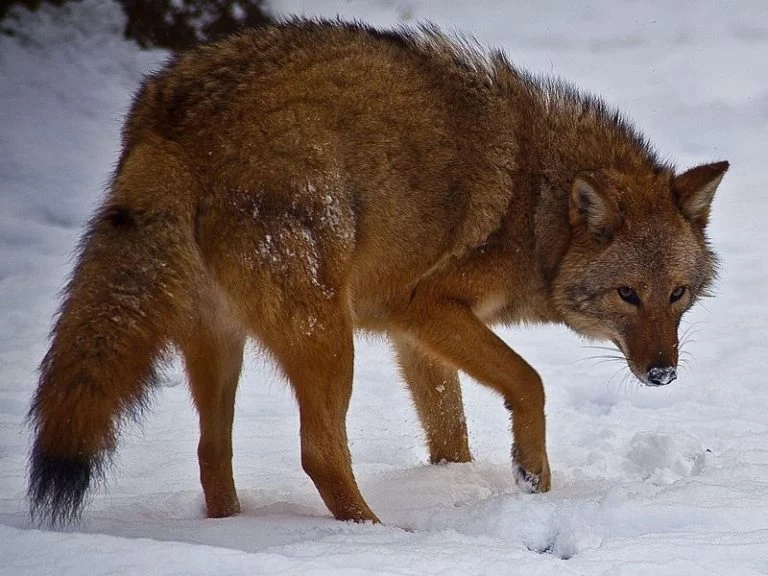
Photo: USFWS Midwest Region, Public domain, via commons.wikimedia.org.