How Wolves Use Smell and Hearing to Read the Wild
4 min read
A wolf pack lives across a territory far bigger than any one wolf can see. Trees block the view, snow hides tracks, and the night is long. So wolves lean on two senses that work at a distance: smell and hearing. I am a wolf enthusiast, not a biologist, so I stuck to what agencies and published studies actually say, and I will flag where the numbers are loose.
What a wolf learns from one sniff
The U.S. Fish & Wildlife Service puts it plainly: a wolf can learn the gender, diet, social rank and breeding condition of another wolf by smell alone. It can also tell how recently the scent was left. That is a lot of information from a patch of urine or a scat on a trail.
This is why scent marking matters so much to a pack. Marks tell wolves from outside the pack that an area is taken, and they tell pack members who has passed through. I wrote about the full picture in how wolves mark territory.
The International Wolf Center says a wolf’s sense of smell is about 100 times greater than a human’s, and that wolves can detect scents from over 1.5 miles away. Treat those as popular estimates. They come from an educational trivia page and I did not find a measured study behind them. The direction is clear, though. Smell is a main tool for wolves, and they can track prey by scent and sound for miles under the right conditions.
Are wolves better sniffers than dogs?
There is one genetic clue. A 2011 paper in the Journal of Forestry Research compared the olfactory receptor genes of dogs and wolves. In dogs, 17.78 percent of those genes were disrupted, against 12.08 percent in wolves. That fits the idea that domestication relaxed the pressure on smell. But the authors reported that the difference was not statistically significant (p = 0.239). So the study does not prove that wolves smell better than dogs. It leaves the question open.
Hearing and the howl
Wolves use howls to defend territory, contact pack members and socialise, according to the 2022 study in the journal Animals by Larsen and colleagues. The same paper notes that howling peaks from July through October, when pups join in and pack howling increases.
How far does a howl carry? The U.S. Fish & Wildlife Service says wolves can hear each other howl over distances of 6 miles in the wild, depending on terrain. The International Wolf Center gives 6 to 7 miles, noting that a howl carries best in the quiet of the night. A 2021 study in Scientific Reports on Indian wolves reports howls that can be detected over more than 6 km, about 3.7 miles. The figures differ because conditions change the range. The sources agree that terrain matters, and the International Wolf Center adds that a howl carries best in the quiet of the night.
In the same Animals paper, many field recordings were unusable because of wind and background noise. That is a useful reminder that a howl heard at the edge of its range is already faint.
Every howl has a signature
The Scientific Reports team found that Indian wolf vocalisations were highly variable within and among individuals. Their computer model identified individual wolves from howls with 98 percent accuracy on the training recordings. On 20 new howls from four wolves, accuracy fell to 75 percent. In the Animals study, individuals within the Arctic and Eurasian subspecies were identified with 80 to 100 percent accuracy.
These are small studies, and the computer models are still being tested. Even so, they suggest what wolves may hear when a howl rolls across a valley: a call that carries the voice of one particular animal.
Howling also does a job in finding partners. The U.S. Fish & Wildlife Service says a primary method for finding a mate is through howling, and that wolves use their sense of smell to find a partner too. For how a pair bond works once it forms, see do wolves mate for life.
Eyesight in low light
Vision gets less attention, but the International Wolf Center says wolves see well in low light, and that good night vision helps them stalk and ambush prey. I could not find a measured source for how far a wolf sees or how it perceives colour, so I will not guess.
What this means when you hear a howl
If you ever hear wolves at night, you are probably hearing a message meant for other wolves miles away. The moon has nothing to do with it, as I explain in the real reason wolves howl, and the wider range of signals is covered in how wolves communicate beyond howling.
Smell and hearing let a wolf read its neighbours without ever meeting them. Where the science gives only rough numbers, I have said so, and I will update this post as better measurements appear.
Sources
- U.S. Fish & Wildlife Service, Leaving the Pack
- International Wolf Center, Fact or Scat trivia
- Larsen et al. 2022, Bioacoustic Detection of Wolves, Animals (PubMed Central)
- Sadhukhan, Root-Gutteridge and Habib 2021, Identifying unknown Indian wolves by their distinctive howls, Scientific Reports
- Zhang et al. 2011, olfactory receptor pseudogenes in wolf and dog, Journal of Forestry Research
Have you heard wolves howl from a long way off, or noticed how a dog reads a scent trail? Add what you know in the comments.
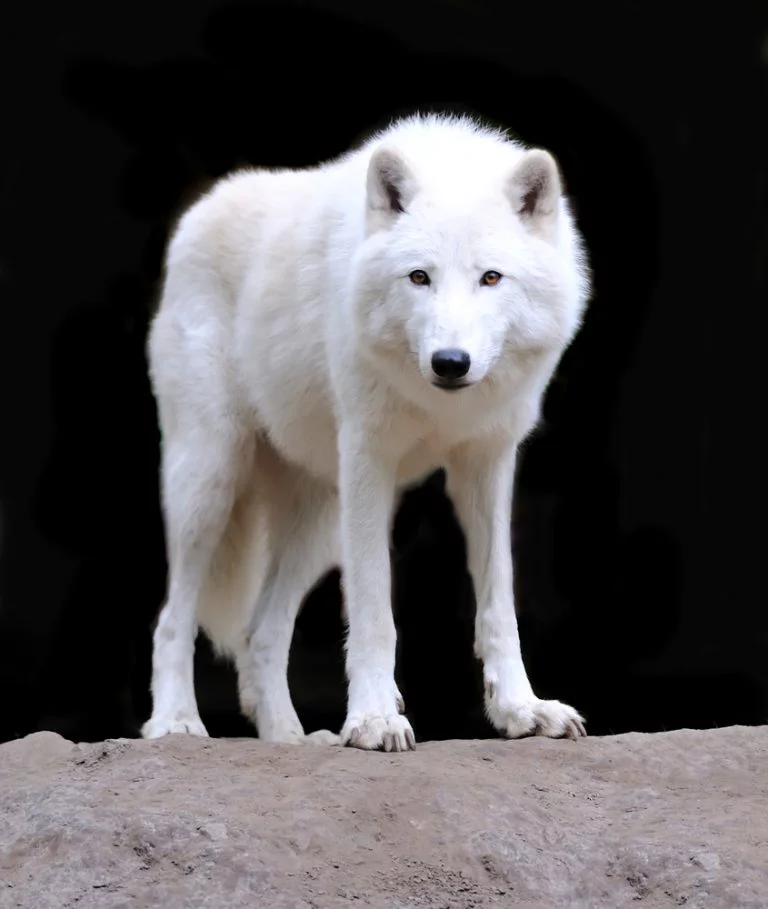
Photo: Fool4myCanon, CC BY 2.0, via commons.wikimedia.org.