How Wolf Pups Grow Up: From Den to Pack
4 min read
Wolf pups are born blind and deaf in late April or early May, weighing around 450 g. They open their eyes at 10 to 14 days, emerge from the den at 3 to 4 weeks, eat regurgitated meat at 4 to 6 weeks, and reach near-adult size by 12 months. A wolf pup goes from a blind 450 g newborn to a 30 kg yearling in 12 months. Key milestones: eyes open at 10 to 14 days, den emergence at 3 to 4 weeks, weaning at 8 weeks, hunting practice at 4 months, full pack membership at 6 months, sexual maturity at 2 years. The whole pack helps raise the pups.
Part of our guide: Wolf Behavior.
Birth (April to May)
Wolf pups are born in a den dug into earth, rocks, or a hollow tree. Litter size averages 4 to 6 pups, with extremes of 1 to 11. Pups are born blind, deaf, and almost helpless, weighing 350 to 500 g. They have soft grey coats and depend entirely on the mother for warmth and milk for the first two weeks.
The breeding female (mother) stays in the den almost continuously for the first 2 weeks. The breeding male and other pack members bring her food. Pups nurse every 2 to 3 hours.
Weeks 2 to 4: eyes open, ears unfold
Eyes open between days 10 and 14, ears unfold around day 14. Eye colour is blue at this stage, changing to yellow or amber over the next several months. Pups start making whimpering and yip noises, the first vocal communication with mother and pack mates.
By day 21 to 28 pups begin venturing outside the den entrance for short periods. They have grown to 1 to 1.5 kg and have started to walk steadily. The whole pack starts coming to visit. From this point pups know the smell and voice of every adult in the pack.
Weeks 4 to 8: regurgitated meat and play
From around 4 weeks pups start eating regurgitated meat that adults bring back from kills. Adults bring back food in their stomachs (carrying meat in jaws over long distances would attract scavengers); the pups nuzzle the corners of the adult’s mouth to trigger regurgitation. By 6 weeks pups are eating less milk and more meat.
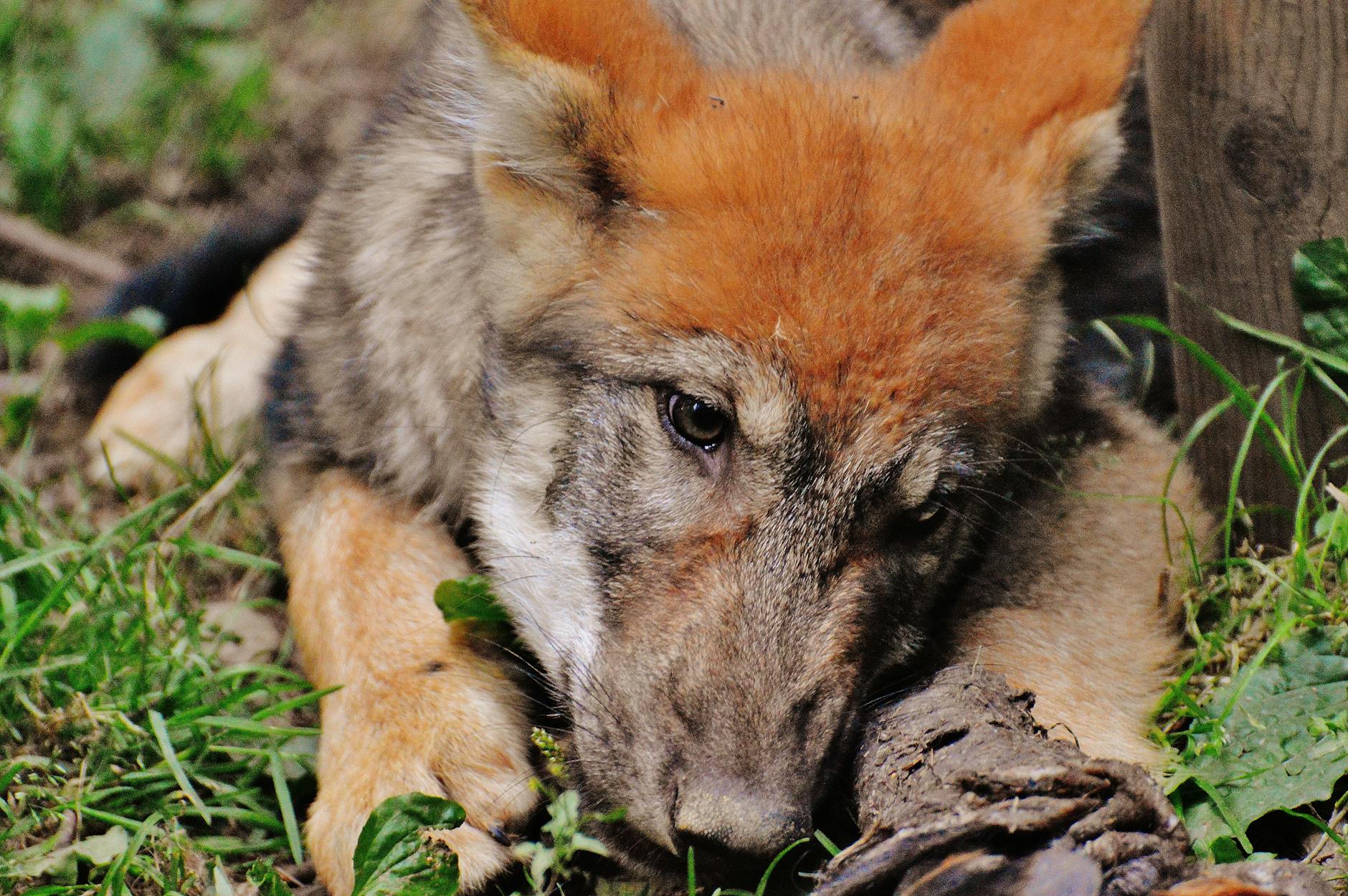
Play is the dominant activity. Pups wrestle, chase, ambush, and practise pounces. This is the foundation of every adult hunting skill. They also learn pack-life basics through play: who is bigger, who can be teased, how to defuse aggression with submissive postures.
Months 2 to 4: weaning and rendezvous sites
Around 8 weeks pups are weaned from milk entirely. The pack moves them from the natal den to a ‘rendezvous site,’ a clearing or wallow where adults can leave pups safely while they go hunt. Multiple rendezvous sites are used over the summer as adults rotate the pups.
At rendezvous sites pups stay until adults return with food. Sometimes a designated babysitter (often a yearling) stays. By 4 months pups weigh 12 to 15 kg, look like miniature adults, and have lost the grey baby coat.
Months 4 to 12: hunting practice and pack integration
From around 4 months pups follow adults to nearby kills and feed alongside them. By 6 months they accompany hunts at a distance, learning prey selection, ambush positioning, and how to behave at a kill. They are still poor hunters individually but their physical size and stamina are growing fast.
By 12 months pups are nearly adult size (25 to 35 kg) and full pack members. They contribute to hunting, scent marking, and pup raising in the following spring. Sexual maturity comes around 22 months. Most disperse to find their own mate between 12 months and 4 years.
What the father does
Male care of the young is uncommon among mammals and routine among wolves. It fits a species in which the breeding pair usually stays together until one of them dies. While the mother stays in the den during the first weeks, the breeding male brings her food, helped by yearlings. Once the pups take meat, he regurgitates for them like every other adult in the pack.
He also guards the den and the rendezvous sites against bears, cougars and, above all, wolves from neighbouring packs. Later in the summer the pups follow the adults across the territory and to carcasses, and learn by watching which prey is worth chasing. Losing the breeding male while the pups are small takes a hunter and a defender out of a small team, and pup survival can fall as a result.
Related reading
For wolf fans browsing for something to take home, see the We Love Wolves store.
Frequently asked questions
When are wolf pups born?
Late April to early May in most of North America and Europe. Higher latitudes mean slightly later births. Gestation is about 63 days from the January-to-March mating season.
How many pups in a wolf litter?
Average 4 to 6, with extremes of 1 to 11. Litter size depends on the mother’s condition and food availability. Many pups die in their first year (40 to 60 percent mortality is common).
When do wolf pups open their eyes?
Between days 10 and 14 after birth. Eyes are blue at this stage and change to yellow or amber over the next several months. Ears unfold and start working around day 14.
What do wolf pups eat?
Mother’s milk for the first 4 to 6 weeks. Regurgitated meat from adults from around 4 weeks onward. Fully weaned by 8 weeks and eating solid prey from kills the pack brings back.
When do wolf pups leave the den?
Around 3 to 4 weeks pups begin emerging for short periods. The whole family moves out of the natal den at around 8 to 10 weeks to a ‘rendezvous site’ clearing where pups stay while adults hunt.
How fast do wolf pups grow?
From 450 g at birth to 12 to 15 kg at 4 months, and 25 to 35 kg by 12 months. Pups reach near-adult size in a year and sexual maturity by 22 months.
Do all the pack members help raise pups?
Yes. Wolf pup-rearing is a pack effort. Yearlings often babysit at rendezvous sites. All adults bring back food, regurgitate for pups, and defend the den from intruders. This ‘cooperative breeding’ is one of the reasons pack structure is so important.
When do wolf pups start hunting?
Around 4 to 6 months they follow adults to kills. By 8 to 12 months they participate in hunts at a basic level. Skilled hunting is learned over the second year.
Last updated 8 October 2026.
Updated 8 October 2026: corrected the gestation period and the wording on pup mortality; merged our post on wolves as fathers into this guide.